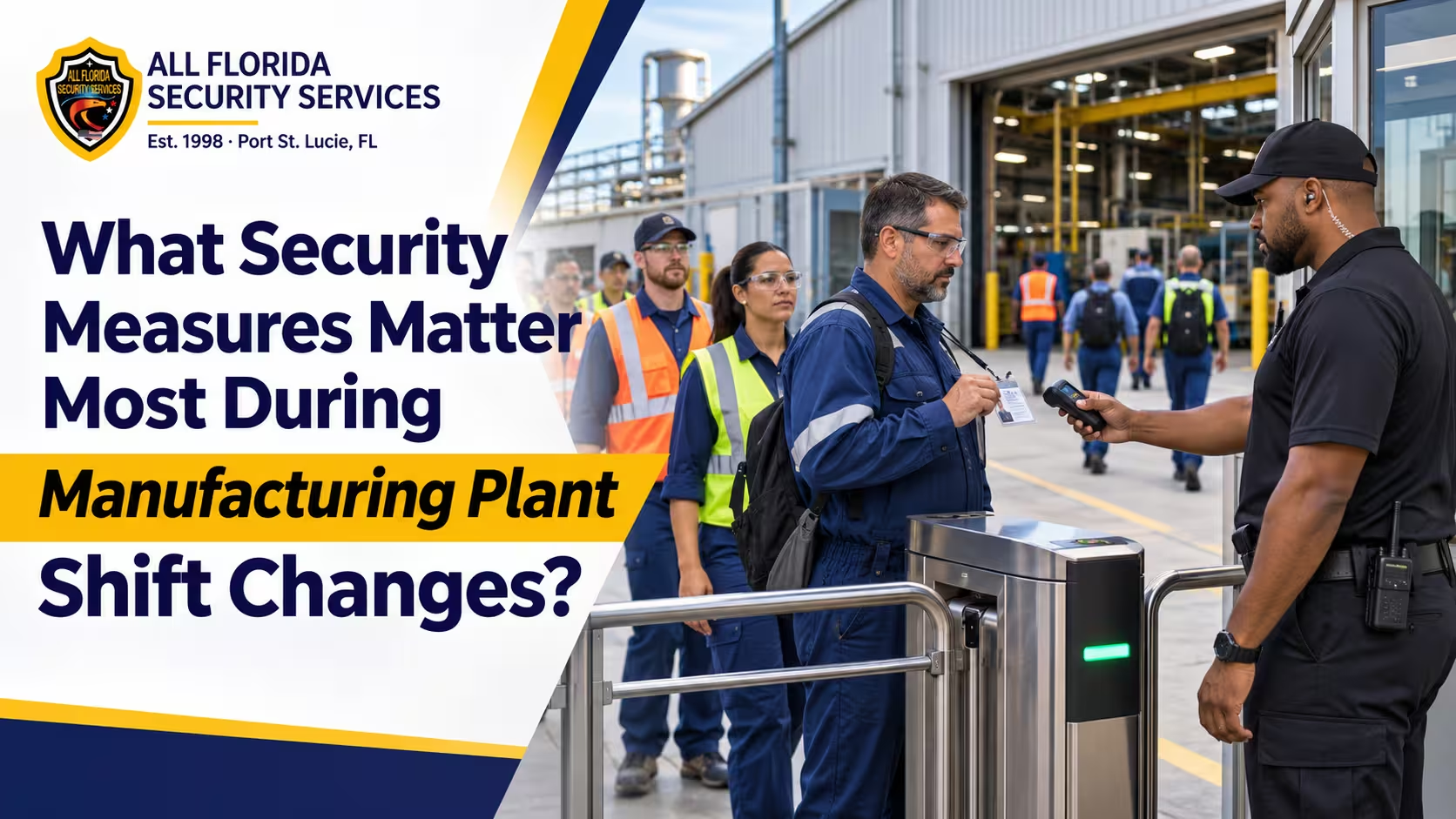
The outgoing shift is finishing its work while the next group of employees arrives at the factory entrance. Workers move through badge checkpoints, contractors wait for approval, and vehicles line up near the security gate. During this busy period, even a brief lapse in supervision can create an opportunity for unauthorized access.
For manufacturing facilities, shift changes require more than simply replacing one group of workers with another. Security officers must maintain entry checks, monitor restricted areas, verify visitors, and exchange important information before handing over their posts. Without clear procedures, small gaps can become serious security concerns.
Why Shift Changes Need a Separate Security Plan
Florida’s manufacturing sector recorded 427,666 jobs across 26,845 establishments in 2024, according to the Florida Department of Commerce. The state also reported 4.7% employment growth from 2022 to 2024. These figures show the scale of the industry and the number of workplaces where employee movement must be managed.
During a shift change, responsibility for work areas, access points, and security decisions also changes. If outgoing staff leave before incoming staff is checked in, accountability can become unclear.
A shift-specific plan should identify:
- When employee entry and exit periods begin and end
- Which doors, gates, and turnstiles remain active
- Who supervises each access point during overlap
- How visitors and contractors are verified
- How unusual activity is recorded and escalated
Verify Employee Badges at Every Active Entrance
Employee badges help confirm authorization. During a crowded transition, workers may follow someone through a secured door or hold an entrance open for colleagues.
Officers should check each badge individually. The access control system should reject expired or unauthorized credentials. Handle badge failures through the plant’s verification process rather than allowing entry first.
Useful badge-check practices include:
- Confirm that the badge belongs to the person presenting it.
- Watch for tailgating and pass-back attempts.
- Direct employees with missing badges to the designated verification point.
- Record repeated access failures or unusual entry attempts.
- Keep visitor and employee procedures separate.
Manage the Overlap Between Incoming and Outgoing Shifts
The overlap needs active supervision as employees move in opposite directions and production continues. An entrance should not be left unattended during a guard change.
Schedule the incoming officer to arrive before the outgoing officer leaves. Use the overlap for a direct briefing, review of active concerns, and confirmation of post responsibility.
| Transition point | Security measure |
| Employee entrance | Maintain badge checks while both shifts move through |
| Vehicle gate | Confirm driver, vehicle, and entry purpose |
| Production floor | Verify access to assigned work zones |
| Guard station | Complete a face-to-face post-handover |
| Visitor desk | Reconcile visitors still inside the facility |
Staggering employee arrival times may also reduce congestion, but changes should be coordinated with production schedules and labor requirements.
Control Contractor and Visitor Check-In
Contractors may arrive to perform maintenance, inspect equipment, or deliver parts. Their access should not depend only on a verbal confirmation at the gate.
Visitor records should capture identity, company, host, purpose, arrival time, and authorized work area. Verify approval with the designated contact before issuing a temporary credential.
Close the visitor record and collect the temporary badge at departure. Confirm authorization and escort requirements before allowing contractor access to restricted areas.
Keep Restricted Production Areas Under Control
Employees and contractors do not need access to every area. Control rooms, inventory storage, equipment rooms, and production lines may have different access rules. Access permissions should match job duties and approved assignments. Familiarity with a worker is not proof of authorization. Refer access discrepancies to the shift supervisor.
Monitor doors left open, alarms, unusual movement, and attempts to follow authorized staff into restricted areas.
Make Guard Post Handovers Specific and Verifiable
A security post handover should transfer responsibility, not just exchange a few casual comments. The outgoing officer should explain current conditions, unresolved incidents, equipment issues, expected visitors, and any temporary access changes.
A useful handover report records:
- Time the post transfer took place
- Names or identifiers of the officers involved
- Access equipment or communication issues
- Visitors or contractors still on site
- Incidents, suspicious activity, and follow-up actions
- Instructions received from plant management
The incoming officer should confirm receipt and check essential communication equipment. Written reports give supervisors a record to review.
Report Suspicious Activity and Coordinate With Plant Management
Employees and guards may notice different warning signs during a shift transition. Examples include someone using another person’s badge, a vehicle waiting near a restricted gate, an unfamiliar person following employees inside, or repeated attempts to enter an unauthorized area.
Security officers should document what happened, when and where it occurred, who was notified, and what action followed. Reports should distinguish observed facts from assumptions. Urgent threats should be escalated through the facility’s emergency procedures.
Plant management should define who receives routine reports, who handles access exceptions, and who has authority to pause entry or request additional support. All Florida Security Services provides manufacturing and industrial security services that include access oversight and coordination with facility operations.
Shift Change Security Review for Plant Managers
A short review before each transition helps confirm that procedures are working in practice. Plant managers and security supervisors can use this checklist during routine inspections:
- All active entrances have assigned coverage.
- Employee badges are checked individually.
- Tailgating and unauthorized pass-back attempts are addressed.
- Contractor approvals and visitor records are current.
- Restricted-area permissions match work assignments.
- Guard handovers include unresolved incidents and access changes.
- Radios, alarms, and communication channels are working.
- Suspicious activity is documented and reported.
- Plant management knows who is responsible for each escalation.
Update the review when shift times, staffing, production schedules, or access points change.
Frequently Asked Questions
Why are manufacturing plant shift changes a security concern?
Several groups move through entrances and work areas at the same time. Without clear coverage and verification, unauthorized entry or missed handovers may occur.
Should security officers overlap during shift changes?
A planned overlap gives incoming and outgoing officers time to exchange information and confirm that post responsibility has transferred.
What should a contractor provide at check-in?
The facility should verify the contractor’s identity, company, host, work purpose, approved area, and authorization before issuing temporary access.
How should suspicious activity be reported?
Officers should record the observed behavior, time, location, people involved when known, notifications made, and actions taken under facility procedures.
Who is responsible for shift change security?
Security officers manage assigned posts and reporting, while plant supervisors and management establish access rules, approve exceptions, and coordinate operational decisions.
Final Thoughts: Maintain Control Through Every Shift
Shift transitions deserve the same attention as other high-traffic periods inside a manufacturing facility. Consistent badge verification, visitor records, restricted-area controls, guard handovers, and clear reporting help maintain accountability while employees and contractors move between shifts.
All Florida Security Services delivers manufacturing and industrial security support focused on access control, security coverage, and coordination with plant management. A defined process keeps responsibility clear as one shift hands operations to the next.