
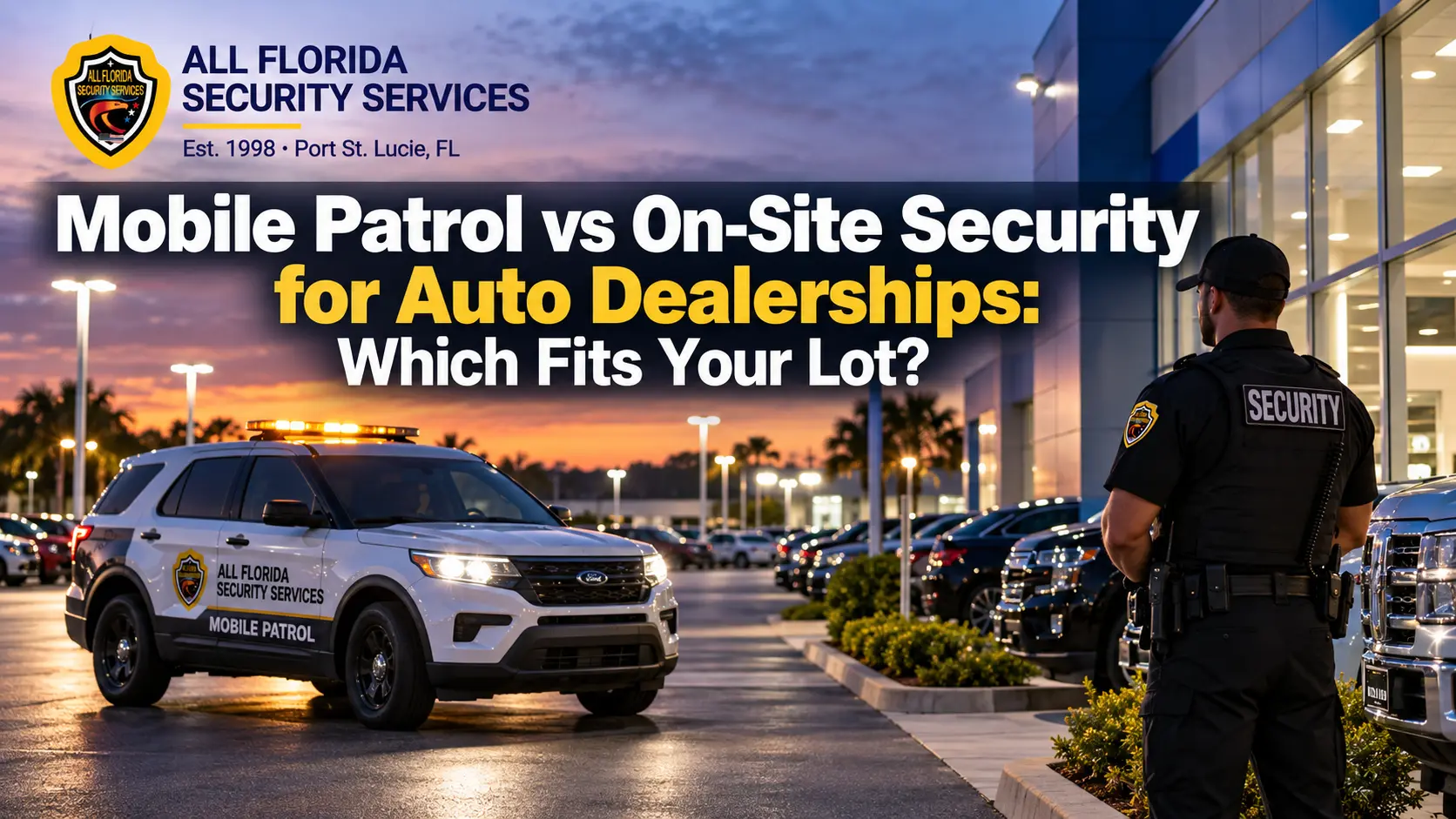
Most dealers who compare guard quotes start with one question: which option costs less? The better question is where your dealership’s risk sits, and at what hours of the day or night it shows up. That answer decides whether you need a guard who stays or a guard who moves.
Get it wrong, and your auto dealership security budget either pays a guard to watch a quiet corner or leaves the back rows with no one watching. This guide compares both models on a real dealership lot, then ends with the questions you should ask any provider before you sign.
How Each Option Works on a Dealership Lot
Both models put a trained guard on your property. The real difference is how that guard spends the night.
On-site security guards hold a fixed security post for a full shift. At a dealership, that post might be the main gate overnight, or the service drive and key room entrance during busy hours. A guard who stays in one place learns who belongs there, so they can spot trouble and act within seconds. But this guard sees only what is in view of the post.
A dealership security patrol uses a marked security vehicle to visit your lot several times a night. On each stop, the patrol officer checks the fence line, tests the gates, walks the back rows, and answers any alarms. Random patrols make it hard for a thief to time a visit around the guard. Between visits, though, the lot is on its own.
Mobile Patrol vs On-Site Security: Side by Side
The table below compares the two models on the five points dealers ask about most.
| Factor | On-Site Guard | Mobile Patrol |
| Coverage | Constant presence at one post | Visits across the whole lot, and across several lots if needed |
| Security response time | Seconds, within view of the post | Depends on where the patrol is on its route |
| Deterrence | A visible guard at the entry point | Unpredictable visits by a marked vehicle |
| How it is billed | By the hour, for every hour of the shift | By the visit, often shared with other sites on the route |
| Best fit | High-value inventory, repeated incidents, busy daytime operations | Fenced lots, overflow lots, and dealer groups with several rooftops |
Per visit billing is generally more economical, since a single patrol officer is assigned to multiple sites on a given night. That cheaper cost does not provide continuous monitoring; it comes with gaps between visits.
So Which One Does Your Dealership Need?
It will depend on your lot size, the value of your inventory, or any incidents that you have had recently. Look at the profile below to see which one matches your store.
| If Your Dealership Looks Like This | Start With |
| A small, fenced lot with cameras and live monitoring | Mobile patrol services with randomized overnight visits |
| A large store with acres of inventory and a separate overflow lot | An overnight on-site guard at the main gate, plus patrols for the overflow lot |
| A dealer group with several rooftops in one area | A shared patrol route that covers every store |
| Luxury or high-demand inventory, or a theft in the past year | On-site security coverage overnight |
| Test-drive fraud or key problems during business hours | A daytime on-site guard near the key room and service drive |
| A one-time high-risk window, such as an inventory day or holiday closure | A temporary on-site guard for those days only |
If that last row sounds like your store, our guide on Security Planning for Vehicle Deliveries and Inventory Days covers short-term coverage in more detail.
Why Many Dealerships End Up With a Hybrid Plan
Most stores don’t have to choose one or the other. Many dealers place on-site guards where they need depth and send patrols where they need breadth. CCTV and live security monitoring ensure that no night goes by without eyes being on the lot between visits. The following is an example of one sample week for a mid-size store.
- During busy Saturdays, there is a guard on duty at the service drive and test-drive return lane.
- A guard is on duty at the main gate overnight.
- An overflow lot is patrolled twice or three times each night at random hours by a mobile patrol.
- Live monitoring monitors camera feeds and notifies patrol when an alarm system or camera alert is triggered.
Questions to Ask Before Signing
Any car lot security service should be able to answer these questions very clearly before you sign a contract.
- How many times is the patrol going to be making the visits per night and are the times random? Predictable schedules let thieves know when the lot is empty.
- What are your ways of establishing that each visit occurred (e.g., GPS logs, scans of checkpoints)? If you don’t establish proof then you are paying only based on trust.
- How many sites are you watching on the same route and what is the typical response time for an alarm? If the route is busy, a short drive may become a long wait.
- Will the guard’s post orders cover dealership tasks, like checking the key room door and gate locks? Generic orders usually miss the places where dealers lose cars.
- How quickly can you get coverage up on an inventory day or holiday rush? Risk can come in a rush and often without notice; that’s why speed is crucial.
Frequently Asked Questions
Is mobile patrol enough to protect a car dealership?
It can be for a smaller lot that is fenced, well lit, and watched by live monitoring. Larger lots, or stores that have had a recent theft, usually need an on-site guard for at least part of the night.
Can a security guard patrol a dealership on foot?
Yes. An on-site guard may take rounds of the lot between periods at the post. Those rounds are conducted over a larger area, but during that time the post is unguarded as the guard is out walking.
Is it necessary for a dealership to have security in the office during regular business hours?
Many do, particularly stores that have to deal with test-drive fraud and busy service drives. A day guard faces a different set of threats than an overnight guard, such as monitoring keys and customer traffic instead of a vacant lot.
Adjust Your Lot Security to Fit the Risk
Begin by identifying on a plot plan of your lot where you have experienced loss or near loss and the times. This map will instruct you on where to have a guard and where they can patrol. All Florida Security Services will accompany you on your property and let you know the type of security coverage that is needed for your property, both on-site and mobile. Give us a call today to schedule a prompt site evaluation.