
A thief who holds the right key to your vehicle doesn’t need to break any windows. The vehicle simply drives off the lot, and the loss may not even be evident until someone goes looking for it days later. That is why effective dealership key control matters more than any single camera or lock setup.
Most stores already lock their keys up somewhere, since it’s the first line on any auto dealership theft prevention checklist. The gaps usually occur in the habits around that storage: who has access to the cabinet, who is responsible for logging the records, and what happens when a key comes back after a test drive. This post covers everything from the day a key arrives at your dealership to the day it leaves, with the rules to set at each step.
Why Keys Are the Weakest Link in Dealership Vehicle Security
Modern vehicles are hard to steal without a working key or fob, which makes the key the real target in dealership vehicle security. Thieves usually get one in one of three ways.
- Key swaps: A fake buyer returns a decoy key after a test drive and comes back later for the real vehicle.
- Relay attacks: Two thieves use radio devices to capture a fob’s signal from inside the building and relay it to the car.
- Insider access: A current or former employee uses what they know about key storage to take a key without anyone noticing.
Each of these schemes depends on a gap in process, not a gap in hardware. The process is the part you must fix first.
Build Vehicle Key Management Around the Key’s Life Cycle
A strong vehicle key management moves through four main stages. In order, those stages are intake, storage, checkout, and return, and a gap at any one of them puts the vehicle at risk.
1. Intake: Tag and Code Every Key on Arrival
A key should be recorded in your system the day its vehicle arrives, not the day someone needs it. Blind codes let staff find the right key while hiding which vehicle it starts from anyone else who picks it up. Tamper-evident rings show at a glance if someone swapped or removed a key.
- Tag every key with a blind code, never the stock number, VIN, or model name.
- Seal each key set on a tamper-evident ring.
- Log every key into the system, including spares, valet keys, and keys for service, loaner, demo, and shuttle vehicles.
- Store duplicate keys apart from the primary set.
For check-in steps when a delivery truck unloads, see Security Planning for Vehicle Deliveries and Inventory Days.
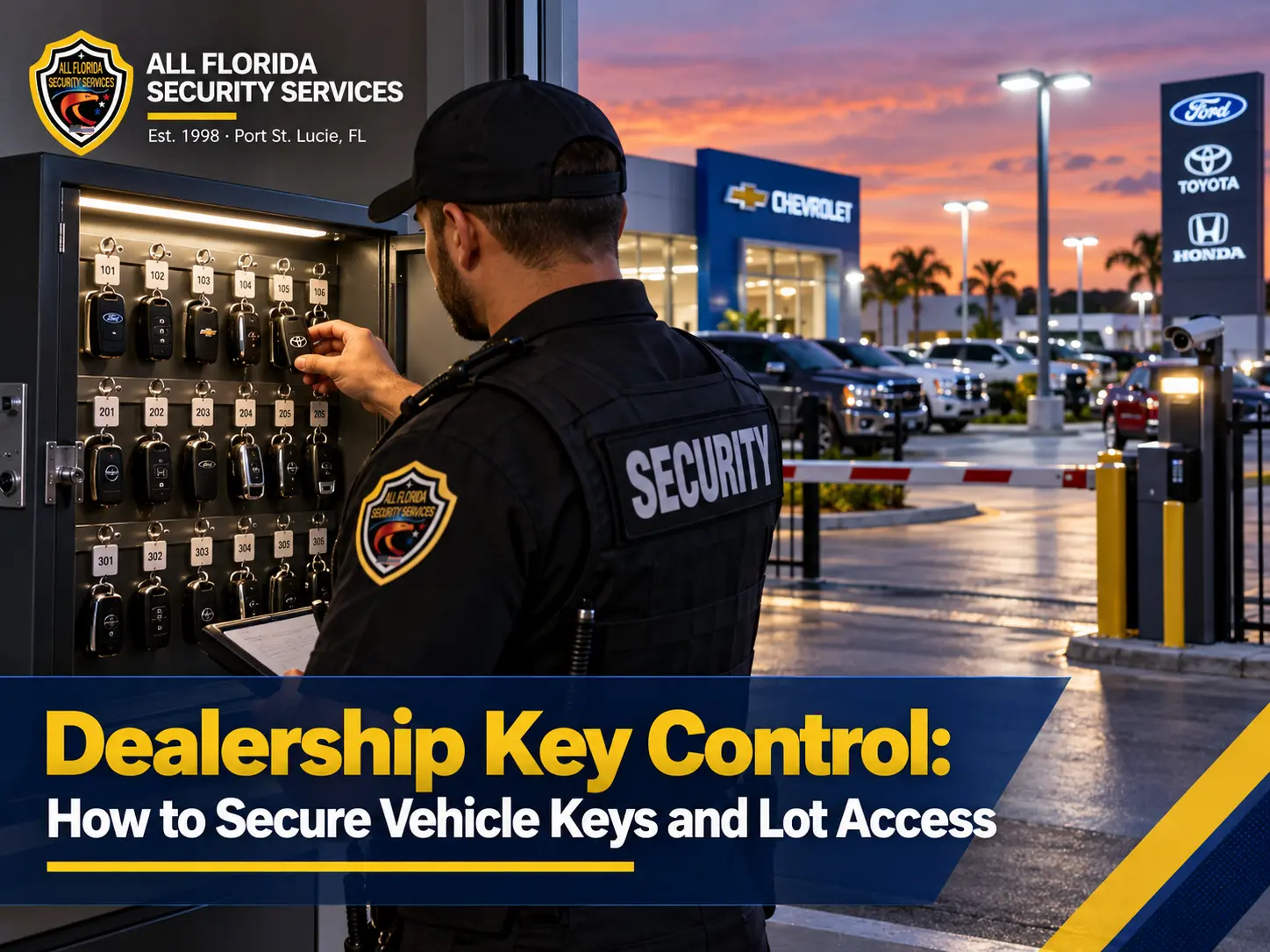
2. Storage: Put the Key Cabinet Where No One Expects It
Where your keys live matters as much as the lock on them. A cabinet behind reception, or a door marked “Key Room,” tells a thief exactly where to look. The best spot sees little customer traffic but stays easy for authorized staff to reach, like a manager’s office. Insurance risk advisors give the same advice.
- Place the key storage area under security camera coverage.
- Fit the key room with a solid, self-closing door that stays locked when no one is inside.
- Keep fobs in signal-blocking cases or pouches to stop relay attacks.
- Change cabinet and key room codes on a set schedule and after any staff departure.
- Connect the key room door to the alarm system after hours.
That alarm is one piece of a bigger night plan, covered in How to Secure a Car Lot After Business Hours.
3. Checkout: Release Keys by Role, Not by Request
If every employee can take any key, the system has no real control. Car dealership access control works best when each role can reach only the keys its job needs, and only during that person’s shift. The table below outlines which role should have which level of acces to your inventory.
| Role | Keys They Can Access | Suggested Limit |
| Sales consultant | Front-line sales inventory | One or two keys at a time, during their shift |
| Sales manager | All sales inventory | Approves release of high-value units |
| Service advisor or technician | Customer vehicles on an open repair order | Only vehicles assigned to them |
| Porter or lot attendant | Units scheduled for a move | Short window, returned right after the move |
| Detailer | Units on the reconditioning schedule | Only that day’s list |
| Outside vendor or transporter | Specific units named by a manager | Manager release only, with photo ID on file |
Issue keys as needed, never as a standing perk of the job. Each employee should check out keys with their own credential, such as a PIN, badge, or employee ID.
4. Return: Match the Key to the Vehicle Before It Goes Back
The return part decides whether an attempted key swap succeeds or fails. The employee who checked out the key should inspect it and confirm it works right before it goes back into storage.
- Check the tag, the ring seal, and the fob itself on every returned key.
- Accept returns only from the employee who checked the key out.
- Fit any after-hours key drop with an anti-fishing baffle and a locked metal box.
- Count all keys against the inventory list at the end of each day.
Manual or Electronic: Choosing a Key Control System
The right key control system depends on your inventory size and how many people handle keys each day. Manual methods can work for a small lot, but they rely on staff writing down every move, every time. Electronic systems record each checkout on their own, which gives managers clean audit trails without extra paperwork.
| System Type | How It Tracks Keys | Best Fit |
| Pegboard or open key box with a paper log | Staff write down each checkout by hand | Very small lots with one or two key holders |
| Locked key cabinet with a manager-held log | A manager releases and records each key | Small stores with a dedicated key custodian |
| Electronic key cabinet or digital key locker | Each user logs in, and the system records every pull and return | Mid-size and large stores, or groups with several rooftops |
Remember that even an electronic cabinet is only as strong as the rules you set in it. If it keeps every employee on full access, it is just an expensive pegboard.
Read Your Vehicle Access Logs for Warning Signs
A log will only help protect your store if someone takes the time to read it. Assign one manager to review vehicle access logs every week and look for these patterns.
- A key that stays out past the end of the employee’s shift needs a reason on record.
- A key pulled after hours, with no scheduled move or service job, deserves a follow-up the next morning.
- One employee pulling the same vehicle’s key again and again, with no deal or repair order attached, can mean someone is setting up a theft.
- Repeated failed PIN or badge attempts at the cabinet point to someone testing access they shouldn’t have.
- A key logged as returned while the vehicle is missing from its spot means both need checking right away.
What to Do When a Key Goes Missing or an Employee Leaves
If you have a key lost, anyone could be able to take your car at any time. The speed of your action is more important here than finding someone to blame. Follow the procedure outlined below:
- Immediately inform the duty manager of the missing key.
- Inspect the log for the last person to use the key and when.
- Move the vehicle to a secure, monitored spot, and disable it if the key doesn’t turn up within the shift.
- Get another key or fob to be programmed again so that the lost one won’t start the car.
- Record the incident, and contact law enforcement for possible theft.
Even if the keys are all turned over, an employee knows where the keys are when they are leaving. Take away any keys or badges, and close that person’s access to the cabinet on the day he or she leaves (or change the PIN number if the cabinet requires a PIN).
Frequently Asked Questions
How frequently is it advisable to count car dealership keys?
Count keys at the end of each day and high value units at each shift change. Short gaps between counts will reduce the amount of time that a missing key can remain undetected.
What can dealerships do to prevent key-fob relay attacks?
Be sure to keep fobs in cases that block signals and be sure the key cabinet is not located near outside walls. Relay devices must be within close proximity to a fob to receive the signal, so shielding and distance go hand in hand.
Who should be allowed to access the key cabinet?
Only staff whose role requires keys should have access, and only for the vehicles related to their work. Each person should use their own credential so the checkout traces back to their name.
Make Every Key Accountable
Start by checking whether every key on the lot is in the system, including spares and service keys. Dealership key control works when every key has a code, an owner, and a record. All Florida Security Services can run a security assessment that reviews your key storage alongside the rest of your property. Book your dealership security assessment today.