
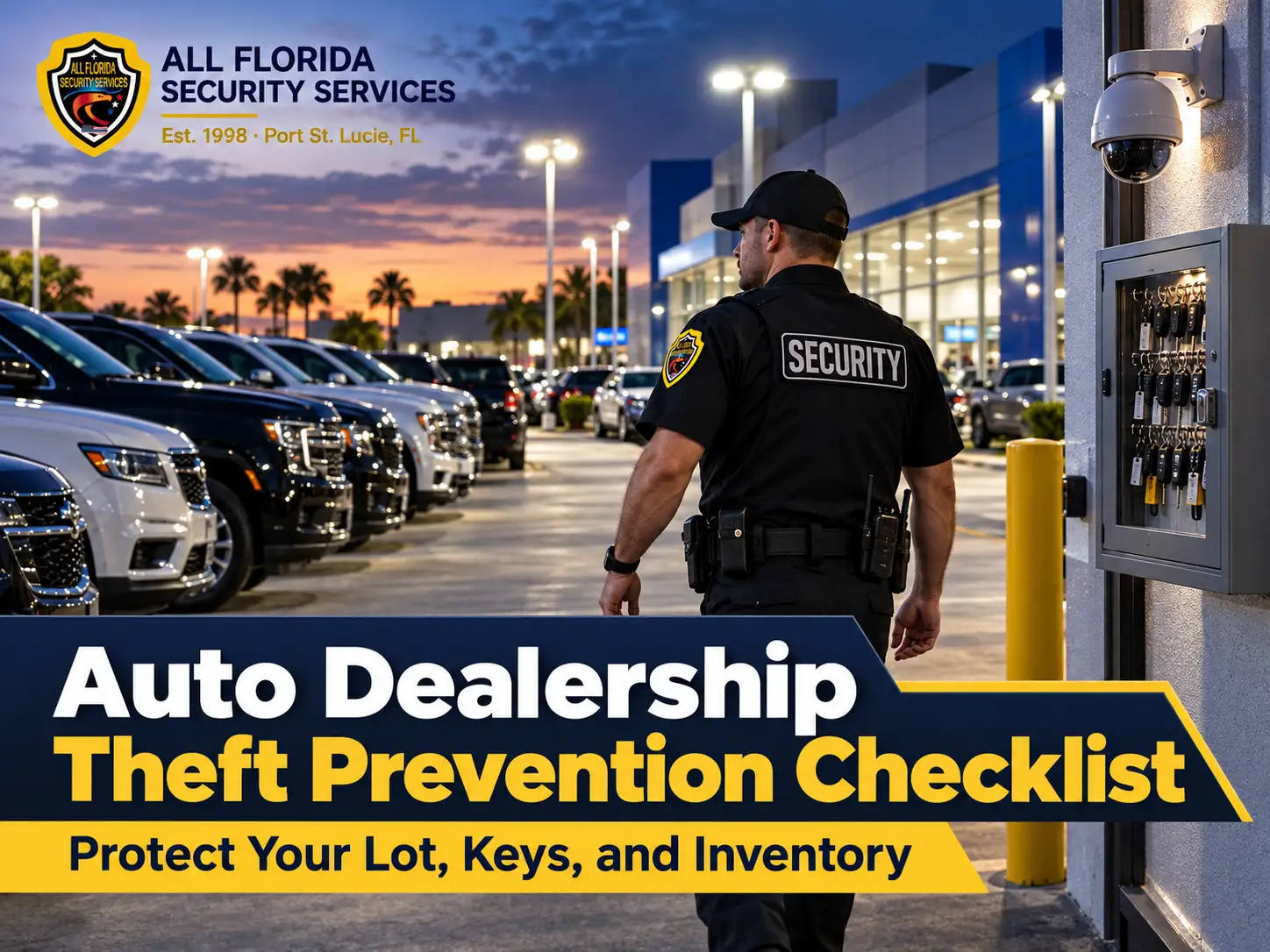
FBI records show nearly 12,000 motor vehicles were stolen from auto dealerships in the US in 2022. Though over 4 years old, the statistic shows the gravity of the theft risk dealerships continue to face every day. Most owners assume it will happen to the store down the road, not theirs. In reality, it happens to those who are least prepared to tackle it. It is your responsibility to ensure that yours is prepared, and this auto dealership theft prevention checklist will help you accomplish that.
You probably already have security cameras on the lot and a lock on the key cabinet. The trouble lives in the gaps between those controls: a camera nobody watches live, a key leaving its cabinet without a log entry, and a rear row of cars that stays in the dark all night. Let’s take a walk around your property with a pen and paper and find those gaps.
Where Thieves Hit a Dealership First
The National Insurance Crime Bureau (NICB) reported 659,880 vehicles stolen nationwide in 2025. It marks a significant decrease from previous trends but even with that downshift, a vehicle gets stolen every 48 seconds. The risk is still high for a lot holding dozens or hundreds of vehicles, with every key kept in one room. Dealerships still remain an efficient target.
Every time we conduct an auto dealership theft prevention audit the same three weak points continue to be found:
- Key storage/service desks: If a thief gets a key, a vehicle can depart without any forced exit or an alarm.
- Overflow rows and rear lots: These are the easiest areas to work without being seen especially when and in poor light.
- Parts departments: Tools, wheels and catalytic converters are lost at service bays and and are often noticed too late.
Many dealers think that theft happens at night, picturing a fence being cut at 3 a.m. Truth is, there are other methods that are more prevalent during the day, like test drive fraud. Key swap is another one when a thief hands you a fake key and returns when it is time to close. The following list is for both shifts.
The Auto Dealership Theft Prevention Checklist: 10 Controls to Audit
The ten controls below follow the order thieves tend to test them, starting with keys and ending with how your team responds when something goes wrong.
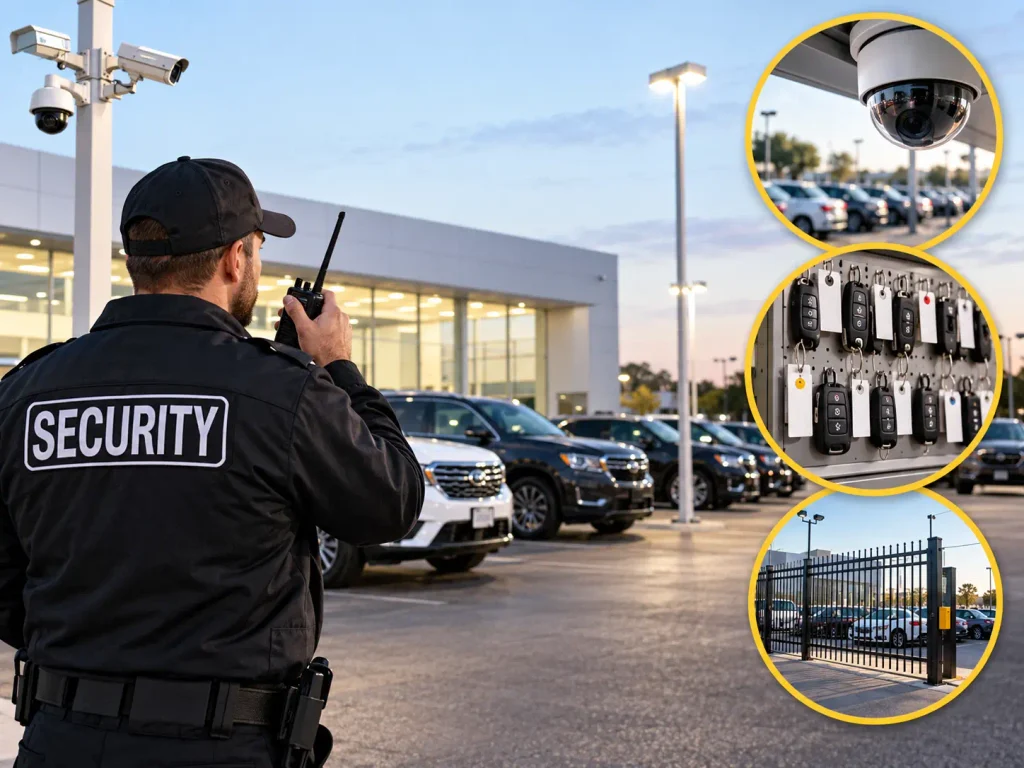
1. Lock Down Keys and Fobs
Keys are the shortest route to a stolen vehicle, which puts them at the center of vehicle theft prevention. A thief who holds a working key skips forced entry, so there’s no broken glass and no alarm to tip anyone off. Watch for two schemes in particular: swapped keys after test drives and relay devices that capture fob signals from inside the building. Make key control your first audit item.
- Store keys in a locked cabinet, key room, or electronic key management system with limited access.
- Log every key checkout and return, including who took it and when.
- Count keys at the end of every shift.
- Inspect each returned key to catch decoys.
- Keep fobs for high-value or often-targeted vehicles in signal-blocking pouches.
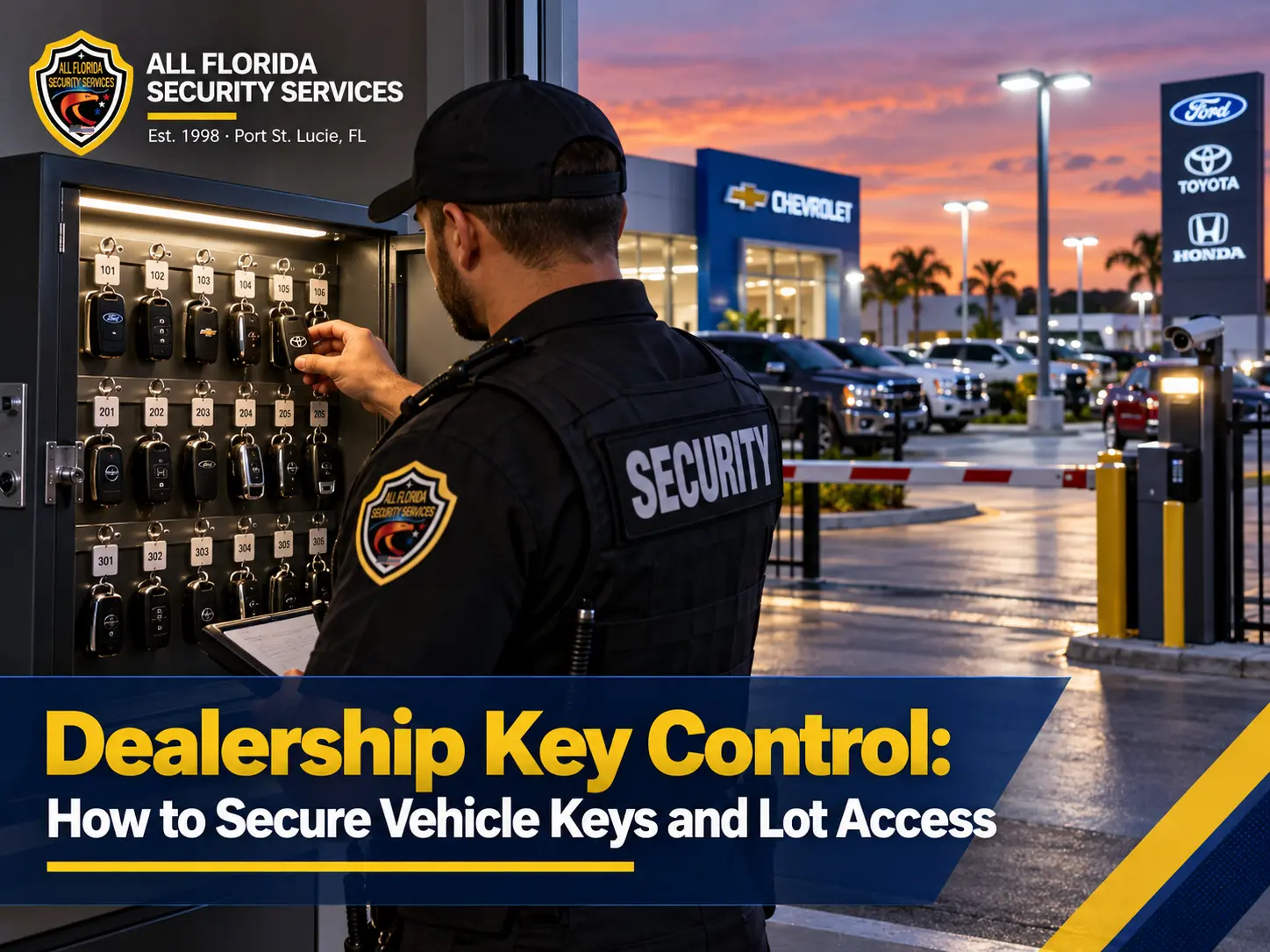
Deeper guide: Key Control and Vehicle Access Security for Dealerships
2. Secure the Perimeter and Lot Layout
A lot with many entry points is hard to watch. Solid auto lot security uses perimeter fencing, gates, and blockers to make a thief work harder and give your staff more time to notice. Large lots gain the most from fewer entrances, since each one is another spot someone has to monitor. Layout choices also cost less than most equipment.
- Close the lot with fencing, gates, bollards, or barriers on every open side.
- Limit entry and exit to as few controlled points as possible.
- Park high-value inventory near the showroom, not in the back rows.
- Keep trade-ins and wholesale units out of unmonitored back lots.
- Fit doors, service entrances, and the showroom with an alarm system.
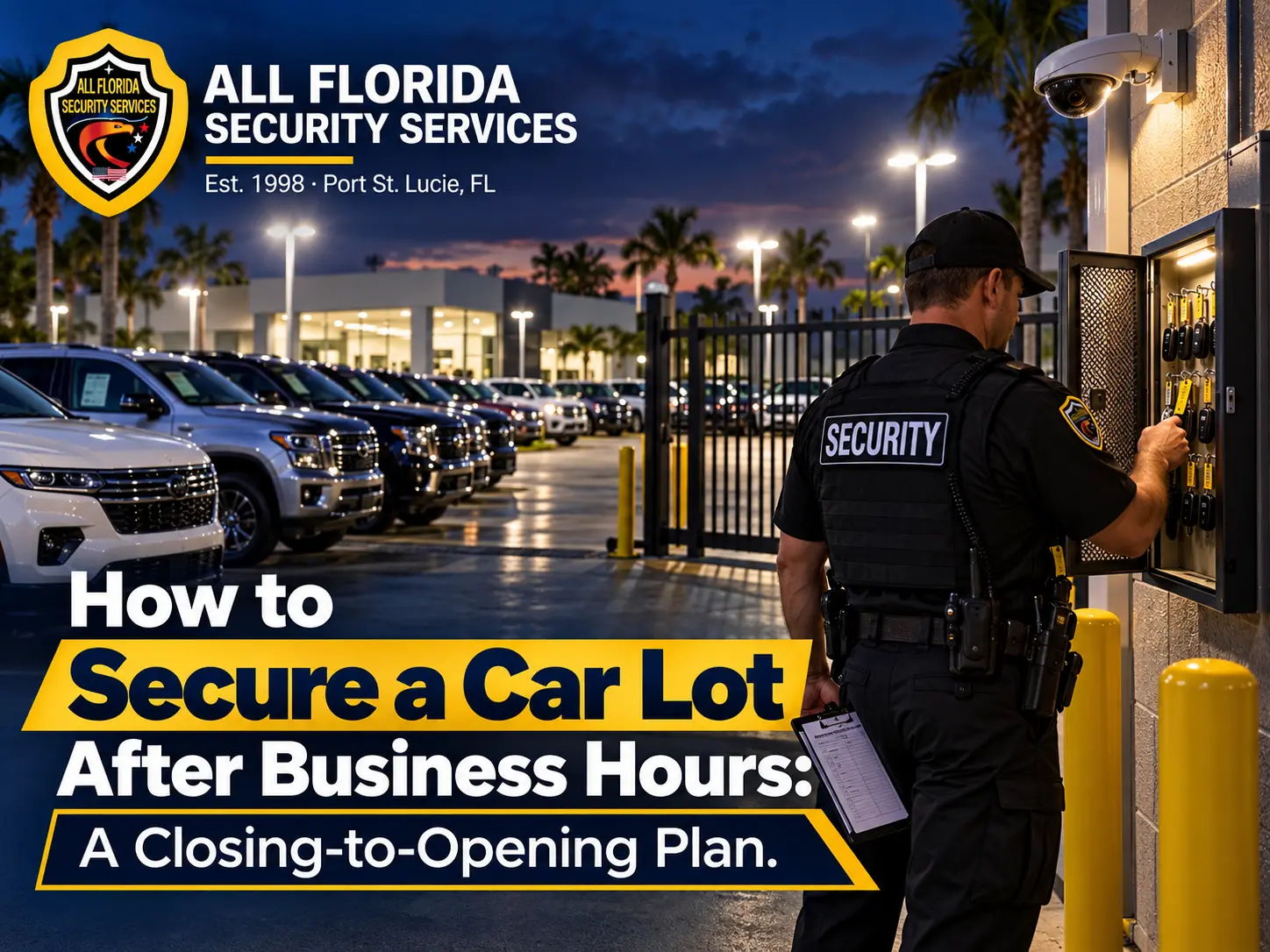
Deeper guide: How to Secure a Car Lot After Business Hours
3. Light the Lot and Remove Blind Spots
Thieves prefer shadows, and every dark corner buys them a few more minutes to work. Walk the lot after dark and note each blind spot, keeping in mind that an evenly lit area deters far better than one with bright patches and dark gaps. Good lighting also protects your staff and customers.
- Light the full lot and building perimeter evenly, with no dark pockets between rows.
- Add motion-activated lights at rear lots, service entrances, and fence lines.
- Test emergency or backup lighting on a set schedule.
- Trim trees and move displays that block lines of sight.
- Re-check lighting after each season change and every lot reconfiguration.
4. Combine Security Cameras with Live Monitoring
A camera can capture the action but a video is not enough to prevent the theft from occurring. Video can assist police in the pursuit of suspects and as evidence in post-incident insurance claims. Live video surveillance is quite different, since a trained individual will be able to identify a trespasser and respond before it’s too late, while the vehicle is on your premises.
- Cover the rear lot, overflow rows, service bays, and key room with security cameras.
- Select cameras that allow for good visibility of faces and license plates at the entrance and exit points.
- Establish after hours monitoring and a call-out procedure.
- Ensure cameras are connected to alarms and/or access control, and that the setup is reviewed for cyber risk.
- Check camera angles frequently for new blind spots.
5. Add Visible Deterrence with Guards and Patrols
A guard at a post or a patrol vehicle rolling through the lot tells a thief that someone is watching. In car dealership security, the right post matters more than headcount, since a guard in the wrong spot turns into a greeter. Trained security guards can document suspicious behavior and escalate it fast. Your choice between on-site and mobile coverage depends on lot size and risk.
- Decide whether your lot needs a stationed security guard, a mobile patrol, or both.
- Post guards where risk builds, such as the key room entrance and the service drive.
- Schedule patrols around opening, closing, and the quiet middle of the night.
- Require written or digital incident reports from every shift.
- Give guards a direct line to a manager.
Deeper guide: Mobile Patrol vs On-Site Security for Auto Dealerships
6. Control Test Drives and Daytime Sales Activity
A test drive hands a stranger one of your vehicles, so treat it as an inventory access event. Fraudsters look for stores where the process feels casual, and steady controls send them somewhere else. Honest buyers accept a professional process without complaint.
- Verify and copy a valid driver’s license before every test drive.
- Use a written test-drive agreement, with manager sign-off for high-value units.
- Set an approved route and a firm return time.
- Escalate any late return right away.
- Photograph customers and their license plates as they enter and leave the lot.
7. Track and Verify Inventory
It can take days for a missing vehicle to be discovered, and sometimes even until audit time. Frequent inventory checks and GPS vehicle tracking reduce the time from loss to discovery. The sooner you know, the higher the chances you will get the car back.
- Schedule comparison of the vehicles on the lot with a vehicle inventory system.
- Use GPS vehicle tracking on high-value stock, and geofence alerts for when units are moved.
- Verify VINs with documents on arrival and departure of vehicles.
- Use wheel locks or immobilizers on vehicles parked outside in an open row.
- Designate one person to be responsible for each reconciliation.
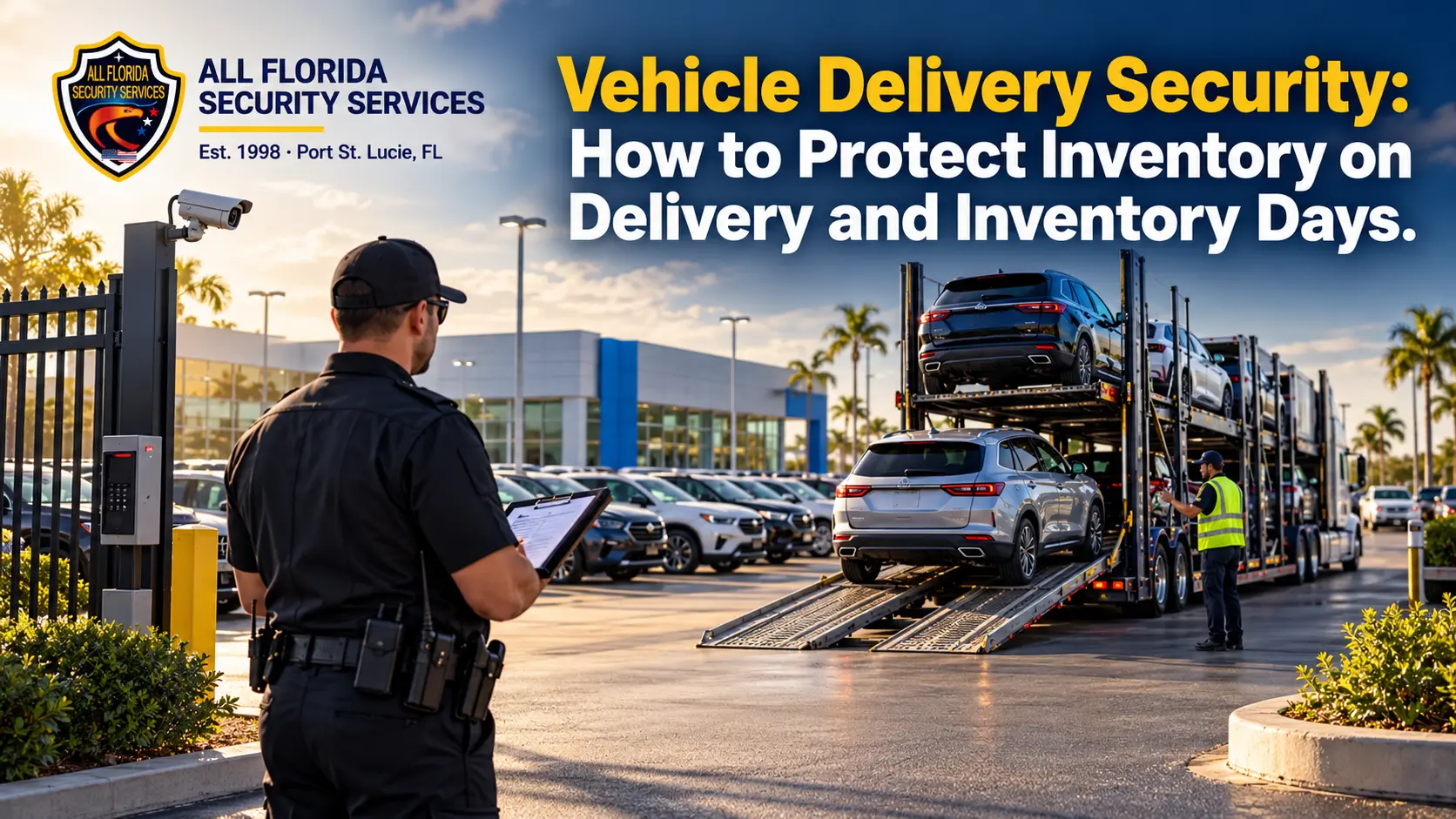
Deeper guide: Security Planning for Vehicle Deliveries and Inventory Days
8. Protect Parts, Wheels, and Service Areas
Parts theft is quiet and quick, and a catalytic converter or a set of wheels can leave in minutes. Your service bays and parts room often hold more small, resalable items than the sales floor does. Treat these areas as inventory too.
- Store wheels, tires, and catalytic converters indoors, not on open racks.
- Lock the parts department and log who enters.
- Park customer vehicles awaiting service inside the fenced area, under cameras.
- Verify identity and paperwork before releasing any serviced vehicle.
- Lock tool storage at the end of every day.
9. Limit Employee Access and Train the Team
Most dealers don’t like to think about internal theft, but it happens at good stores with good people. Limiting employee access to the key room, parts, and the F&I and cashier offices removes temptation and makes any problem easier to trace. Training turns every employee into part of your security team. Staff who know the red flags catch problems early.
- Grant access to sensitive areas only to those who need it, and review the list often.
- Use an access control system with individual credentials where possible.
- Train staff on security procedures, fake IDs, and decoy keys.
- Teach staff to flag anyone lingering where they have no reason to be.
- Make it clear that internal theft leads to dismissal and prosecution.
10. Prepare Your Incident Response and Reporting
Confusion in the first ten minutes of an incident can cost you your best chance of recovery. A written response plan tells each person whom to call and what to save, including camera footage and key logs. Clean records also support your insurance claims.
- Write down who calls law enforcement, who calls the manager, and who calls your insurer.
- Preserve camera footage and key logs the moment an incident occurs.
- Record every attempted theft, not only the ones that succeed.
- Share what you learn with other local dealers and your dealer association.
- Review each incident within a week and update this checklist.
How to Use This Dealership Theft Prevention Checklist
Walk the property with this list in hand and mark every item as Done, Partial, or Missing. Fix the Missing items in key control and monitoring first, because those two areas lead to the fastest losses. Have a manager and a lot or service lead score it together, so one person’s blind spots don’t decide the result.
Turn the Checklist into a Routine
A checklist you finish once goes stale within a season. The table below gives each task a rhythm and an owner, so you don’t have to depend on someone’s memory.
| Frequency | What to Check | Who Owns It |
| Every shift | Key counts, returned-key inspection, test-drive log | Sales or desk manager |
| Daily | Camera feeds, lighting status, late-return list | Operations manager |
| Weekly | Physical inventory vs. system list, GPS alert review | Used-car or inventory manager |
| Monthly | Employee access list, incident reports, parts room audit | General manager and fixed-ops lead |
| Quarterly | Night-time lot walk, blind-spot review, response plan refresh | General manager with security provider |
When to Bring in Professional Security Support
Some dealerships can run this checklist with their own staff and keep losses low. Others reach a point where car dealership security needs outside help, usually once incidents repeat or the inventory is worth too much to leave to chance. A security provider brings trained eyes, live response and the kind of documentation a busy sales team can’t keep up with. The following are indicators to respond to.
- If there are recurring problems or unexplained missing keys, your key system requires an outside look.
- If a theft or attempted theft has taken place in the past year, then thieves have had time to do a study of your lot.
- A large lot with dark rear rows is difficult to staff watch.
- As insurance claims increase or your insurance rate goes up, it signals that your carrier is recognizing increasing risk.
- If there is a staff safety concern with customers, trespassers, or after-hours activity, trained guard presence is required.
Documented security measures can support an insurance claim when a loss does happen. Ask your insurer whether specific controls, such as monitored cameras or a guard service, affect underwriting or your premium. The answer may help justify the investment.
Frequently Asked Questions
These are the questions dealers ask most often when they start an audit.
What should an auto dealership theft prevention checklist include?
A strong dealership theft prevention checklist covers keys and fobs, perimeter and lot layout, lighting, and cameras with live monitoring. It should also address guards or patrols, test-drive controls, inventory tracking, employee access, and incident response. A routine that repeats the checks matters as much as the list itself.
What are the ways thieves break into cars at dealerships?
Almost all vehicle thefts at dealerships can be broken down into three possible methods: stolen or swapped keys, relay theft of fobs, and entry after-hours in the dark in unmonitored rows. Visible deterrence and regular checking routines are crucial in vehicle theft protection, as thieves tend to conduct reconnaissance before their crime.
Do security cameras deter theft?
There is a difference between cameras just filming events and live monitoring. Cameras alone don’t deter theft, it is the live monitoring that does it, particularly when you pair it with a clear response plan. However, camera footage is still a great aid to police and insurers in case something does go wrong.
Start With the Weakest Link
Start with whichever item you marked Missing first, which for most stores is key control or after-hours monitoring. Auto dealership theft prevention improves one gap at a time, not all at once. All Florida Security Services can walk your property with you and show you the lot the way a thief would see it. Contact All Florida Security Services today to book your dealership security assessment.