
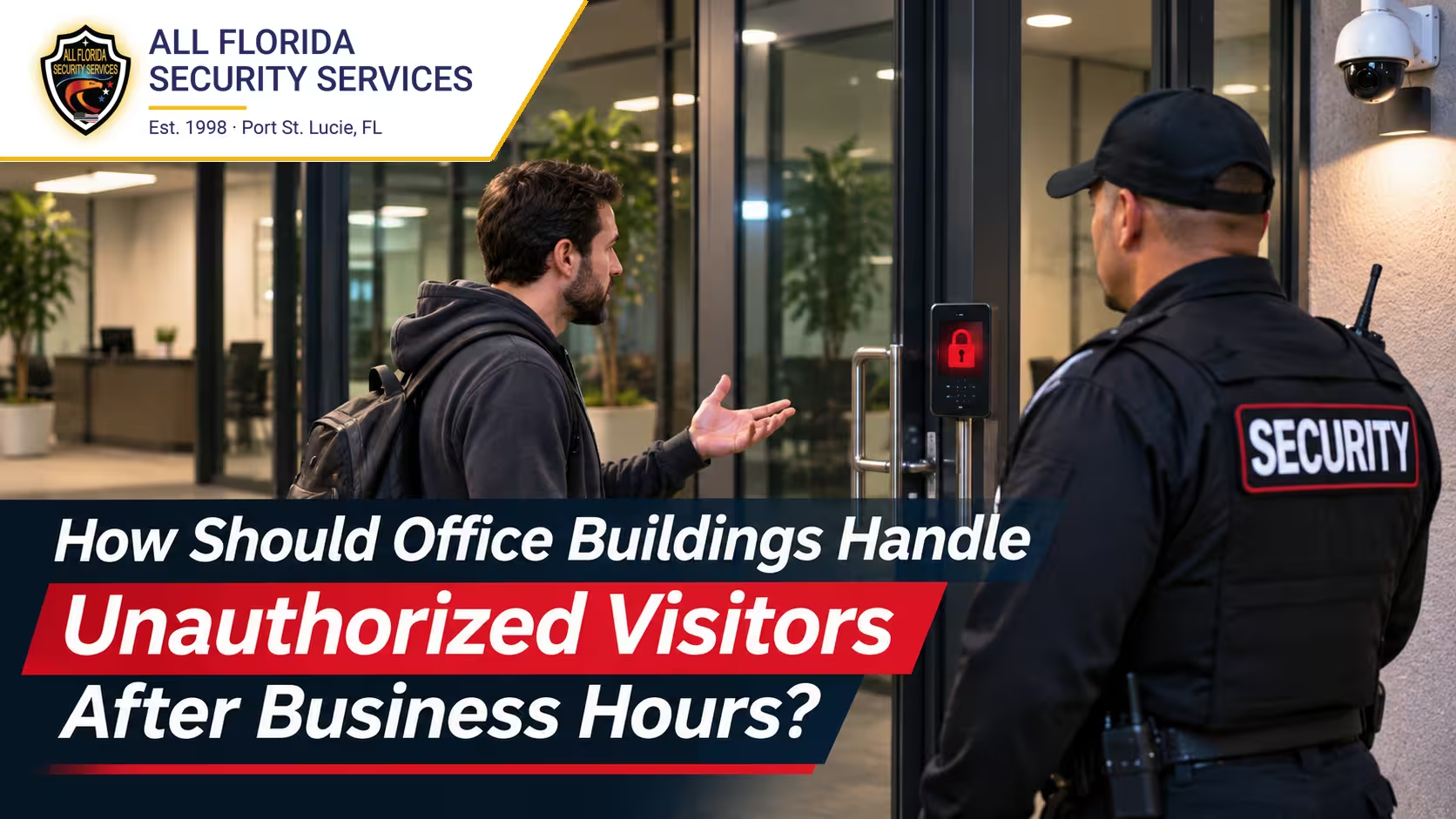
Commercial office buildings may remain active after the workday ends. Employees, cleaning crews, contractors, and tenants may still need access, while fewer staff members are available to verify who belongs inside. This creates opportunities for unauthorized visitors to test entrances or persuade someone to let them through.
After-hours office building security requires clear verification, controlled entry, and a measured response that protects tenants without creating unnecessary confrontations.
Why After-Hours Entry Attempts Require a Different Approach
During the day, reception staff and employees can often confirm visitors. At night, tenant contacts may be unavailable, and one security officer may cover several areas.
Watch for behaviors that warrant verification:
- Trying multiple locked doors after being denied access.
- Following an employee through a secured entrance without using credentials.
- Asking to enter but being unable to identify the tenant or contact they are visiting.
- Pressuring a guard to make an exception or claiming that someone is waiting upstairs.
- Attempting to reach restricted floors, stairwells, or tenant areas without approval.
These actions do not automatically prove criminal intent. They are reasons to follow access procedures rather than make assumptions.
Verify the Visitor Before Unlocking a Secured Door
Visitors should explain who they are meeting and why. Security should verify requests through an approved tenant contact, not a number supplied only by the visitor.
| Verification step | What security should confirm |
| Identity | Visitor’s name and identification, when required |
| Destination | Tenant, employee, department, or office |
| Reason for entry | Visit purpose and expected timing |
| Authorization | Confirmation from a designated tenant contact |
| Access limits | Approved entrance, floor, and escort requirements |
| Record | Time, decision, and relevant details logged |
| Helpful note: If a tenant does not answer, that is not authorization. The officer should use the property’s alternative verification process or deny entry until permission can be confirmed. |
Control Entrances Without Disrupting Authorized Tenants
Buildings may have lobby doors, garage connections, loading areas, side entrances, stairwells, and tenant suite doors. Managers should designate after-hours entrances and secure the others.
| Entry point or area | After-hours control |
| Main lobby | Visitor verification before entry |
| Side and rear doors | Keep secured unless specifically designated |
| Parking garage | Credential-controlled access to the building |
| Stairwells | Restrict movement to authorized floors |
| Server rooms and records areas | Separate authorization, not general visitor access |
| Loading area | Confirm scheduled deliveries or contractors |
Access cards should be assigned individually and not shared. Lost credentials, departed employees, and changed tenant permissions should be addressed promptly. A visitor approved for the lobby or one tenant’s reception area should not automatically gain access to other floors or sensitive spaces.
Respond Calmly When Authorization Cannot Be Confirmed
Consistent procedures help officers avoid improvising. The guard should explain the policy, keep the door secured, and offer a next step, such as contacting the tenant or returning when someone can authorize entry.
Response guide
- Cooperative visitor: Explain the verification requirement and help them contact the tenant using approved details.
- Visitor who refuses the process: Do not open the door.Report the refusal to a supervisor and make sure it is properly documented.
- Repeated door testing or attempted tailgating: Maintain a safe position, alert other assigned security staff if available, and follow escalation procedures.
- Forced entry, threats, or immediate danger: Activate the building’s emergency response plan and contact law enforcement or emergency services as appropriate.
Officers should not turn an access dispute into a physical confrontation. Decisions should be based on behavior and risk, with occupant safety prioritized.
Real-Life Example: Someone Claims They Forgot Their Laptop
At 9:30 p.m., a visitor arrives and says they need to retrieve a laptop from a fourth-floor office. They have no access card, cannot provide a tenant contact number, and ask the guard to let them in because someone inside is expecting them.
The officer checks the approved tenant directory and attempts to contact the designated representative. If nobody confirms the request, access remains denied. The guard records the visitor’s stated purpose and the verification attempt. Once the person leaves, staff can complete the incident report and close the case. If they begin testing other doors or attempting to follow tenants inside, the officer alerts the supervisor and follows the building’s escalation plan.
This avoids relying on a persuasive story and gives management a record if the visitor returns.
Document the Incident So Management Can Follow Up
Incident logs help managers review events and identify patterns. Specific observations are more useful than a vague note that someone was “suspicious.”
An after-hours incident report should include:
- Date, time, and entrance involved.
- Visitor’s name or description, if available.
- Stated reason for requesting access.
- Tenant contacted and verification outcome.
- Whether entry was denied or approved with restrictions.
- Actions taken, supervisor notifications, and whether the visitor left.
- Witnesses and available camera footage.
Reports should distinguish facts from assumptions, recording observed behavior rather than conclusions about motives.
Prepare the Procedure Before the Building Closes
Property managers, tenants, and guards should agree on procedures in advance. A written policy should define authorized contacts, verification methods, entrances, escort rules, denied-entry steps, and escalation thresholds.
After-hours readiness checklist:
- Tenant after-hours contacts are current.
- Approved entrances and restricted doors are clearly identified.
- Visitor verification steps are available to guards.
- Escort and tenant authorization rules are defined.
- Supervisors and emergency contacts are listed.
- Incident reporting and camera review procedures are established.
All Florida Security Services provides business complex security, helping commercial properties maintain security coverage, controlled access, and consistent responses to after-hours visitor concerns.
Frequently Asked Questions
Should a guard let someone in who claims to work in the building?
Not solely on their claim. The guard should check credentials or confirm authorization through the building’s established procedure before granting access.
What if the tenant does not answer the phone?
Follow the alternative verification procedure. If authorization cannot be confirmed, deny entry and explain how the visitor can arrange access later.
Should every office entrance be locked at night?
Unused doors should remain secured. Buildings can designate a controlled entrance for tenants and approved visitors while restricting other access points.
When should security contact law enforcement?
Forced entry, threats, weapons, or an immediate safety concern may require emergency assistance. Officers should follow the building’s escalation plan and avoid unsafe confrontation.
Final Thoughts: Consistent After-Hours Visitor Security
Office buildings can reduce unauthorized entry by verifying visitors, securing secondary entrances, limiting access to approved destinations, and documenting incidents. A consistent process allows guards to handle legitimate late-night requests professionally while responding appropriately when permission cannot be established.
All Florida Security Services provides business complex security, helping property managers protect commercial buildings, manage after-hours access concerns, and support a controlled environment for tenants, employees, and authorized visitors.