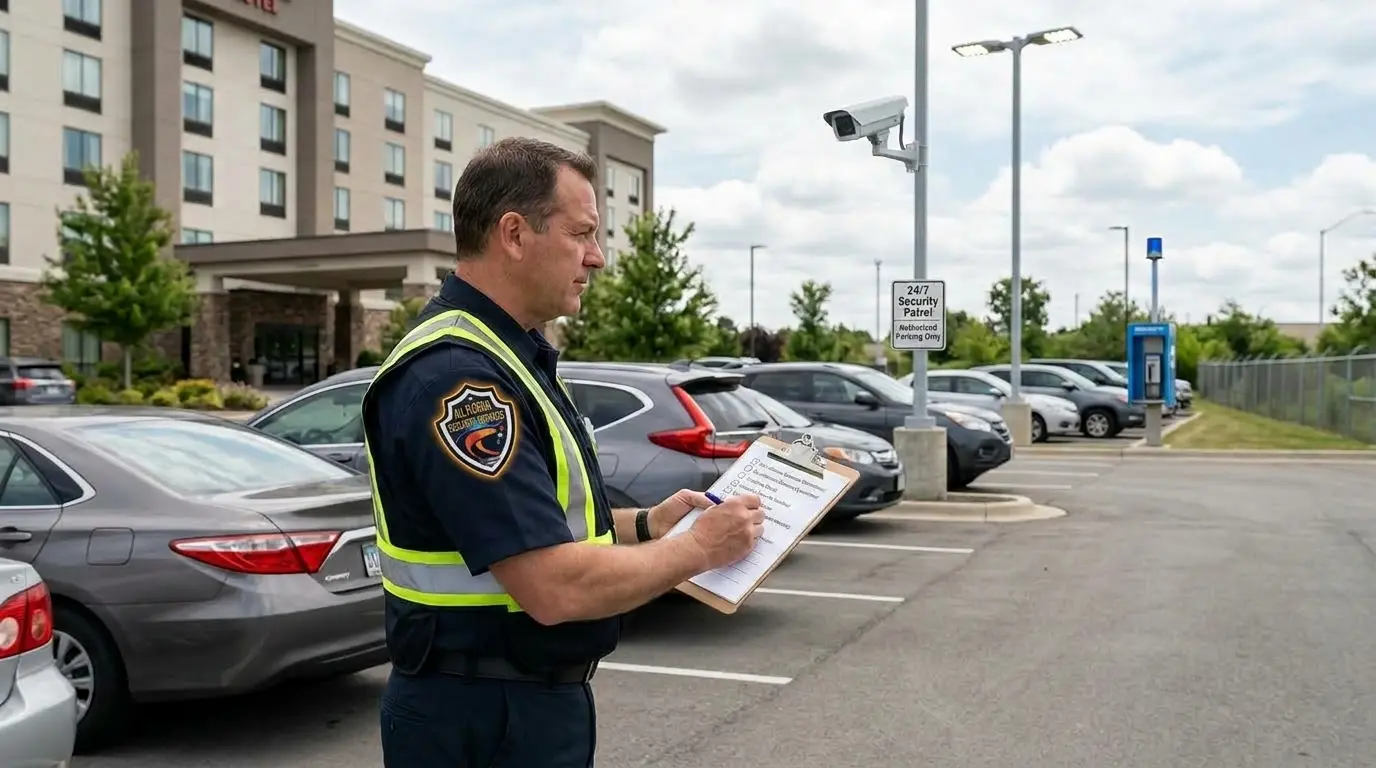
The parking lot is the part of a property that gets the least attention. It sits outside the front desk’s sightline, outside the retail floor, outside the office lobby. That gap is the reason it draws criminal activities that would never happen a few feet away, inside a monitored building. Guests walking to their cars at night, employees leaving a late shift, and the property managers who answer for what happens in between all share the same exposed space.
This parking lot security checklist covers essentials like lighting, access control, cameras, patrols, and incident response. It is built to flex between a hotel’s overnight guest flow and a commercial site’s shift-based traffic.
Why the Parking Lot Needs Its Own Security Plan
Parking areas combine three conditions criminals look for: public access, high-value unattended property, and limited surveillance. A locked car sitting in an open parking lot is a far easier target than the same car parked in a monitored garage. All it takes is a few unwatched moments for an opportunist to cut out a catalytic converter. Most lots hand that opportunity over for free.
A theft or assault that happens in a parking lot is not usually contained to that incident. It can trigger a liability claim, a wave of negative reviews, and a lasting drop in how safe guests or employees feel on the property. A parking lot safety checklist is cheaper than a lawsuit. Property managers who treat the lot as a security zone equal to the building interior manage to avoid most of this exposure.
A well-run lot delivers real value back to the business:
- Fewer opportunities for theft, vandalism, and violent crime
- Lower insurance and liability exposure over time
- A visible signal to guests and staff that the property takes their safety seriously
- Documentation that protects the business if an incident is ever disputed
The Parking Lot Security Checklist: 7 Categories to Inspect
This is your ultimate parking lot security checklist. Walk it quarterly, after any incident, and before a seasonal traffic spike. The categories work together. Strong cameras don’t make up for poor lighting, and a locked gate doesn’t help much if nobody is patrolling behind it.
1. Lighting and Blind Spot Elimination
Lighting is the cheapest, highest-leverage item on this list, because a well-lit lot deters crime before it ever starts.
- Test every fixture at night and replace any bulb below full brightness
- Map dark corners and stairwell entries — behind dumpsters, between light poles, along shadowed fence lines
- Add motion-activated lighting in areas that remain poorly lit, like dumpster enclosures
- Confirm poles are not blocked by overgrown trees or new signage
2. Fencing, Gates, and Vehicle Access Control
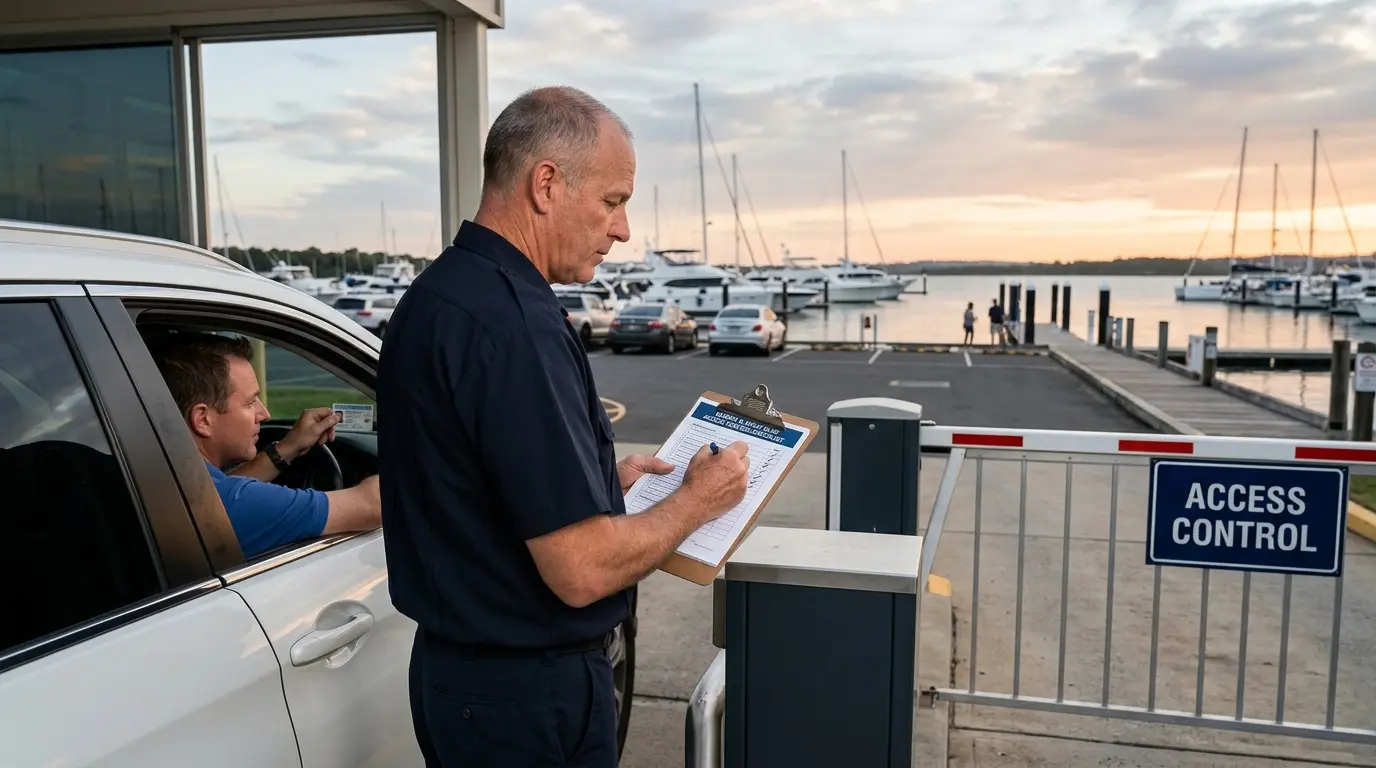
Access control decides who enters the lot in the first place, and that matters more than anything.
- Perimeter fencing: Inspect for gaps, cuts, or leaning posts along the full line.
- Gates: Confirm automated gates close fully and manual gates aren’t propped open.
- Climbing aids: Remove anything near the fence that could help someone scale it.
- Entry points: Funnel vehicle traffic through as few entrances as the site can reasonably support.
3. Security Cameras and Video Surveillance Coverage
Your entire CCTV coverage is only as good as its weakest angle; a parking lot with ten cameras and one blind spot still has a blind spot.
- Confirm cameras cover every row and walkway with no unmonitored gaps
- Check lenses are clean and unobstructed
- Test night and low-light performance and image quality
- Confirm the system supports remote monitoring so a team can watch the area live, not just review footage afterward
4. Security Guards and Patrol Routes
Whether physically staffing a lot with security guards or choosing a hybrid arrangement with focus on remote surveillance, this is a decision you will have to make based on your specific circumstances. A guard covers one area at a time, while a monitoring system covers every camera at once.
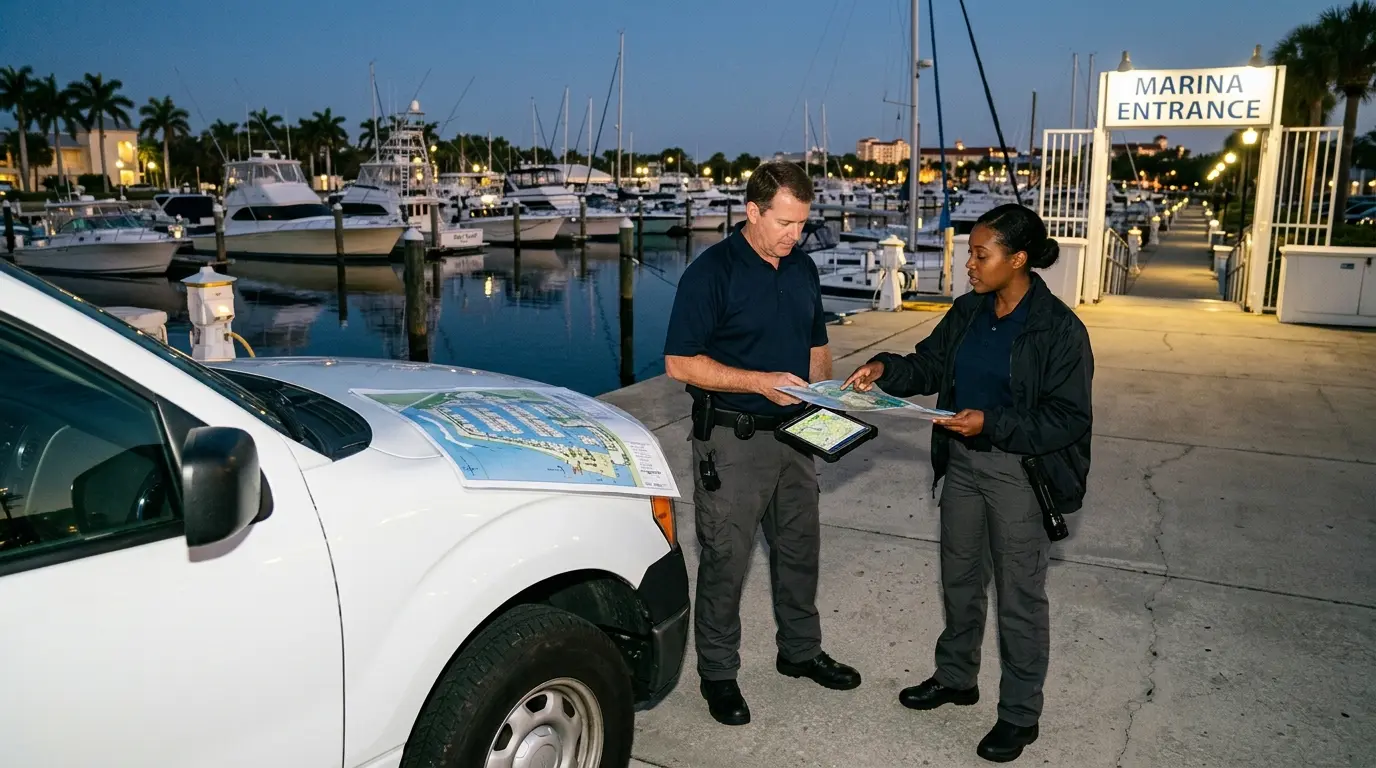
- Coverage type: Choose foot patrols, vehicle patrols, or remote monitoring based on lot size and risk level.
- Patrol routes: Set a documented schedule that reaches every zone, including far corners.
- Escalation protocol: Confirm guards know exactly when and how to contact law enforcement.
- Licensing: Verify contracted guards are licensed and briefed on site-specific post orders.
5. Signage, Traffic Flow, and Pedestrian Routes
Unclear rules create the same vulnerability as an unlocked gate.
- Confirm signage on hours, rules, and towing policy is visible
- Verify directional signage makes entry and exit lanes obvious
- Separate pedestrian routes from active driving lanes where possible
- Replace faded or damaged signage before it stops being legible from a car
6. Landscaping and Grounds Maintenance
Overgrown landscaping creates a hiding spot, and it signals that a property is not closely watched.
- Trim vegetation near entrances, fence lines, and camera fields of view on a fixed schedule
- Remove litter and graffiti promptly rather than on a delayed cycle
- Confirm dumpster enclosures don’t create concealment near walkways
- Inspect pavement for potholes or cracks that signal neglect
7. Emergency Contacts and Incident Response
This checklist closes with the category that matters most after something has already gone wrong.
- Emergency call stations: Test monthly and repair immediately if any station fails.
- Posted contacts: Display police, fire, and property management numbers at more than just the entrance.
- Incident documentation: Use one report template for every incident so records stay consistent.
- Video retention: Confirm footage is retrievable quickly when police or an insurer request it.
Hotel Parking Lot Security: What Guests Expect That Employees Don’t
The core checklist applies everywhere, but hotels carry a few pressures that a corporate office lot never has to deal with. Guests are unfamiliar with the property, often arrive at odd hours, and frequently leave luggage sitting visible in the back seat. That combination makes hotel lots an attractive target for opportunistic theft. Guests judge their whole stay starting from the lot on whether they felt safe or not.
Valet operations too need the same scrutiny as the rest of the lot: key handling and the valet stand itself all need proper lighting and camera coverage.
A hotel lot rarely closes, so patrols and remote monitoring need to run on a schedule that matches actual guest arrival patterns, including late check-ins. Hotels can also use hotel security guard services to maintain a visible security presence during late-night arrivals and departures.
- Extend camera coverage and lighting to valet stands, luggage drop zones, and covered entry canopies
- Schedule patrols or monitoring checks around late-arrival and early-departure traffic, not just daytime hours
- Train front desk and valet staff on how to flag suspicious activity to security without alarming other guests
- Post a visible, guest-facing safety message near the lot entrance so travelers know the property is actively monitored
Commercial Parking Lot Security: What Retail, Office, and Mixed-Use Sites Need
Commercial parking lot security has to account for employees arriving and leaving outside business hours, often before sunrise or well after sunset. That is when the lot is emptiest and least watched. Build lighting and patrol schedules around your shift-change times rather than standard business hours. A beautifully lit lot at dawn does nothing for the employee walking to a car at 11 p.m.
Commercial lots often serve several tenants at once. A retail strip, a restaurant, and an office suite can share a parking lot with overlapping traffic and no single party clearly responsible for the whole space. That ambiguity is exactly where maintenance and security gaps show up. Property managers should assign one accountable party for the shared lot.
- Align lighting and patrol timing with employee shift-change hours
- Assign one accountable party for shared-lot maintenance and security across multiple tenants
- Coordinate camera and access-control systems across tenants so coverage doesn’t stop at a lease-line boundary
- Flag high-theft zones, such as loading docks, for extra lighting or camera priority
How to Run a Parking Security Assessment
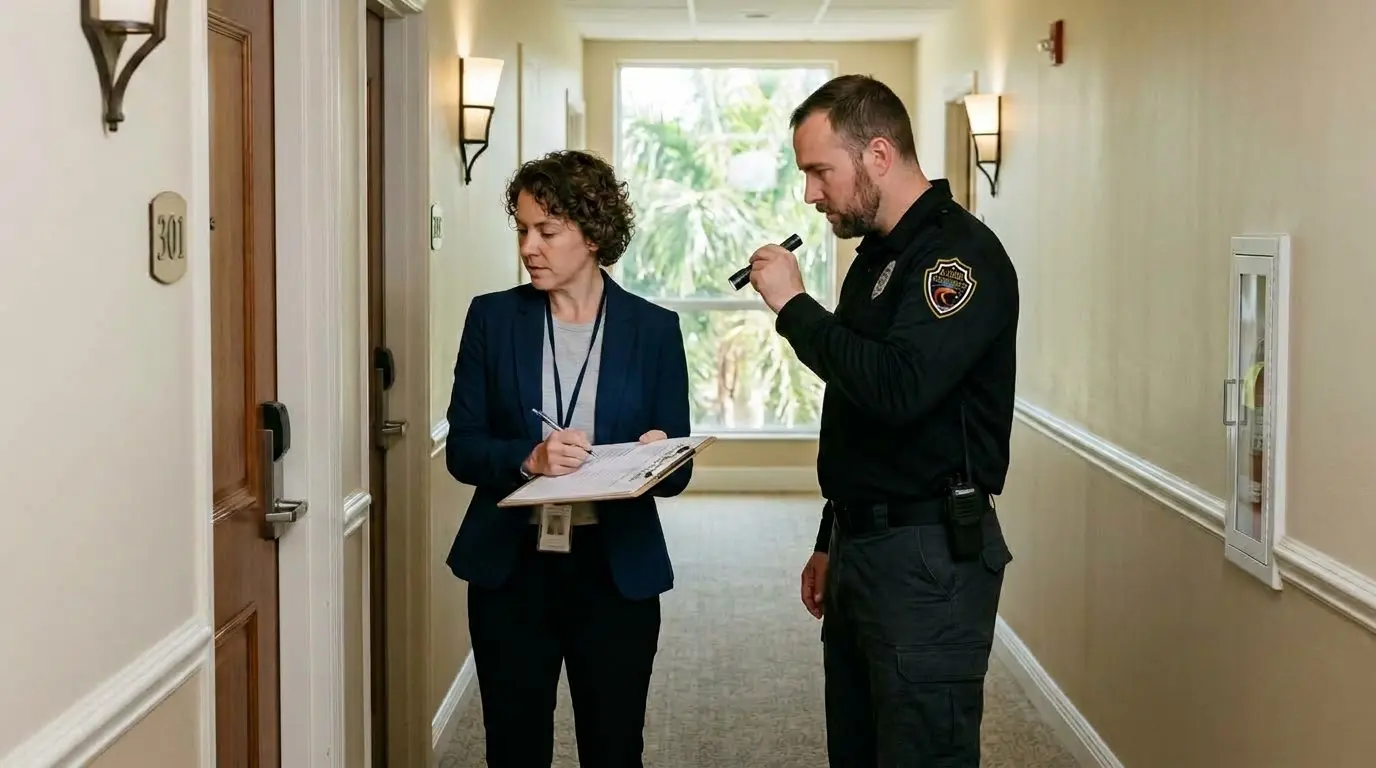
A parking security assessment is the process of scoring the checklist above against a consistent standard, on a set schedule, so you can identify problems early. Use a simple rating approach (pass or fail, or a short numeric scale) for each category. Add an open notes field for anything that does not fit a clean checkbox, like a broken gate reported that week.
Match your inspection frequency to actual risk instead of applying one blanket schedule to everything. Lighting and emergency access lanes deserve a nightly or daily check. Camera and fencing condition hold up fine on a weekly check. Signage and line markings only need a monthly look. Add a walkthrough after every reported incident, and before any known seasonal traffic spike, like a holiday weekend.
Here is the part most assessments miss: a finding that did not get fixed is worse than no assessment at all. It creates a paper trail showing the property knew about a hazard and still didn’t act on it. Assign every failed item an owner and a fixing deadline the moment it’s logged.
Where Video Surveillance and Remote Monitoring Fit In
Recorded-only cameras help after an incident, but remote monitoring systems let an operator spot suspicious behavior as it develops and step in. Many systems also enable the operator to issue a live audio warning. However, this technology only extends the assessment between walkthroughs. It does not replace one. A live camera cannot tighten a loose gate hinge or trim a hedge on its own.
- Score each checklist category on a consistent pass/fail or numeric scale
- Log an open note for anything unusual, including flagged suspicious behavior, with time and location
- Match inspection frequency to risk — daily for lighting and access lanes, weekly for cameras and fencing, monthly for signage
- Assign a responsible owner and a deadline to every failed item at the time it’s recorded, not afterward
Get a Professional Parking Security Assessment from All Florida Security Services
A checklist gets you most of the way there, but a trained eye catches what a walkthrough alone can miss. All Florida Security Services works with hotels and commercial properties across Florida to assess parking lot risk, place trained parking lot security guards where they matter most, and build a monitoring plan that fits the property’s actual traffic patterns. Contact us to schedule a walkthrough and get a security plan built around your lot.
Frequently Asked Questions
How often should a parking lot security checklist be completed?
Walk the full checklist at least quarterly, and add a check after any reported incident or before a known high-traffic period. Lighting and emergency access lanes hold up better with a nightly or daily glance rather than waiting for the quarterly round.
Do security cameras alone reduce parking lot crime?
Cameras help document incidents and can deter crime, but coverage gaps and poor lighting limit how much they prevent on their own. Pairing cameras with adequate lighting, clear sightlines, and either patrols or remote monitoring closes the gap that cameras alone leave open.
Who should be responsible for parking lot security at a commercial property?
Ownership should sit with one accountable party (usually the property manager) even when the lot serves multiple tenants with separate leases. Splitting responsibility across tenants without a single owner is one of the most common reasons for unaddressed maintenance and security gaps.