Maybe you are scheduling a quarterly hotel security walkthrough. Maybe your insurer flagged a renewal review. Maybe something happened last month and leadership wants answers before it happens again. Whatever brought you here, you need a checklist that actually works for a Florida property, not a generic security audit template built for a motel in Ohio.
Most hotel safety checklists skip what Florida law specifically requires. This article adds three things on top of the standard checklist: the state’s human trafficking training law, hurricane-season emergency planning, and Florida’s negligent security liability standard. Finish this post and you’ll be able to walk your property once and leave with a documented, defensible audit.
What a Hotel Security Audit Actually Covers
A hotel security audit is a structured walkthrough that tests whether existing controls actually work as designed. During the audit, you check the performance of locks, cameras, staff protocols, and emergency systems in real time. A camera that is just there isn’t the same as a camera that’s recording correctly and is actually reviewed when something goes wrong. An audit exists to find the gap between the policy binder and what happens on the night shift.
People use “assessment,” “audit,” and “checklist” interchangeably, but they do different jobs. A hotel risk assessment identifies which threats matter most for your specific property, which really comes down to your location. A beachfront resort and a highway motel face completely different exposure. The audit then tests the controls built to address those threats. The checklist is what makes the audit repeatable across shifts and staff turnover.
Florida raises the stakes here more than most states. Year-round visitor volume and a constantly shifting guest population increase exposure to theft, unauthorized access, and trafficking-related activity. Florida courts also have a well-developed body of premises liability case law, holding property owners accountable when a security failure leads to guest harm.
Hotel Security Risks a Florida Property Audit Must Account For
Before you run through the checklist, it helps to know exactly what you are checking for. Each risk below maps to a specific weak point that shows up again and again in Florida properties.
- Unauthorized access: Guests, staff, and vendors moving into rooms or back-of-house areas they have no reason to enter, often through propped doors or shared key codes.
- Theft and property crime: Belongings taken from rooms, vehicles, or public areas, frequently linked to poor lighting or unmonitored parking structures.
- Human trafficking activity: Hotels remain a documented venue for trafficking due to guest anonymity and high room turnover, which is why Florida law now mandates staff training on recognition and reporting.
- Fire and life-safety failures: Outdated alarm systems, blocked exits, or unmaintained sprinkler systems that turn a small incident into a life-threatening one.
- Cybersecurity exposure: Guest payment data and personal information moving through hotel Wi-Fi and property management systems that were never hardened against intrusion.
- Severe weather and hurricane impact: Florida’s storm season introduces structural, evacuation, and communication risks that most national checklists never mention.
- Violence and civil disturbance: Altercations in bars, event spaces, or parking areas that escalate faster without visible staff presence or a response protocol.
Each of these risks maps directly onto a section of the hotel property security checklist below, so you can jump straight to the control that addresses your highest-priority exposure. The checklist is organized the same way most Florida DBPR inspectors and insurance underwriters walk a property: from the perimeter inward.
The Hotel Security Audit Checklist
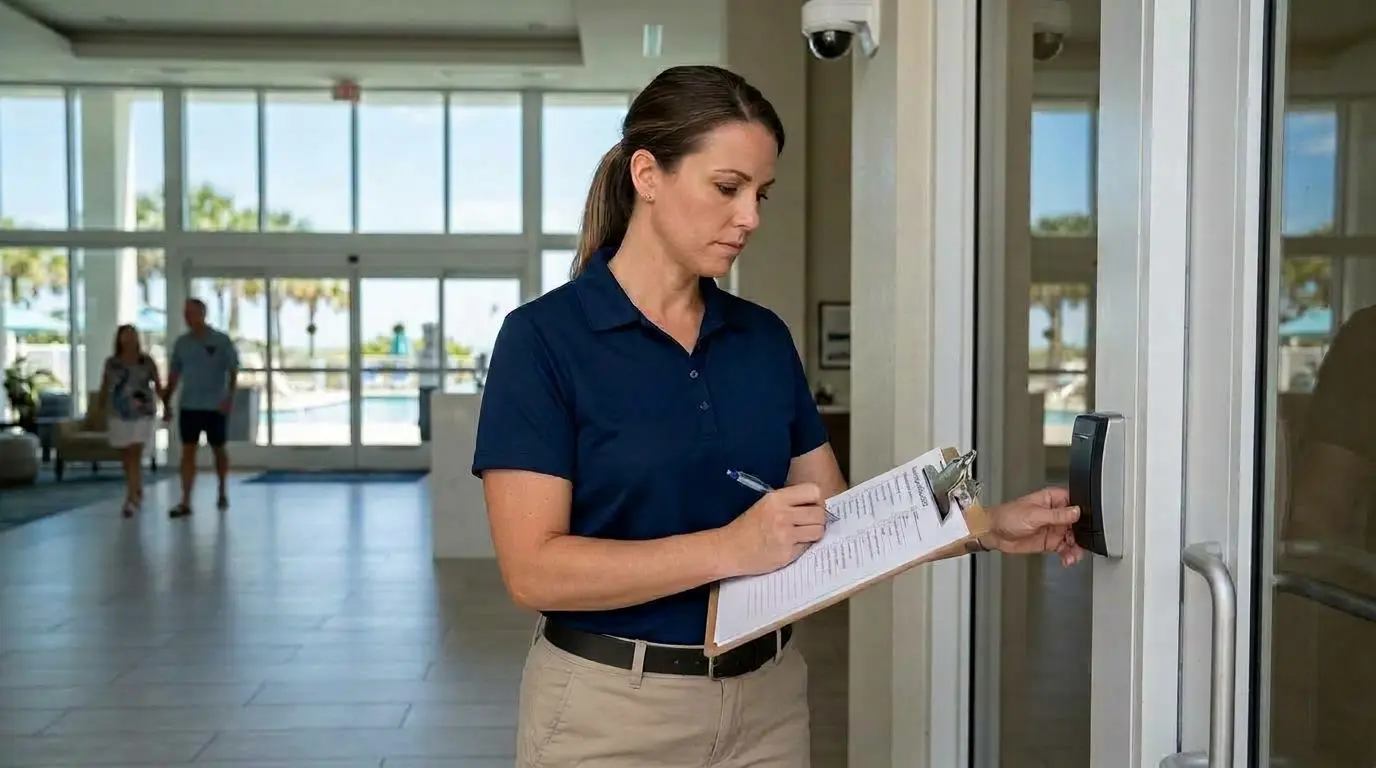
Walk the property in the same order every quarter. Photograph any failed item on the spot, and assign a staff member to fix it before the walkthrough ends. For a checklist to deliver meaningful improvements, it is important to assign an owner for each finding.
Perimeter, Entrances, and Parking Areas
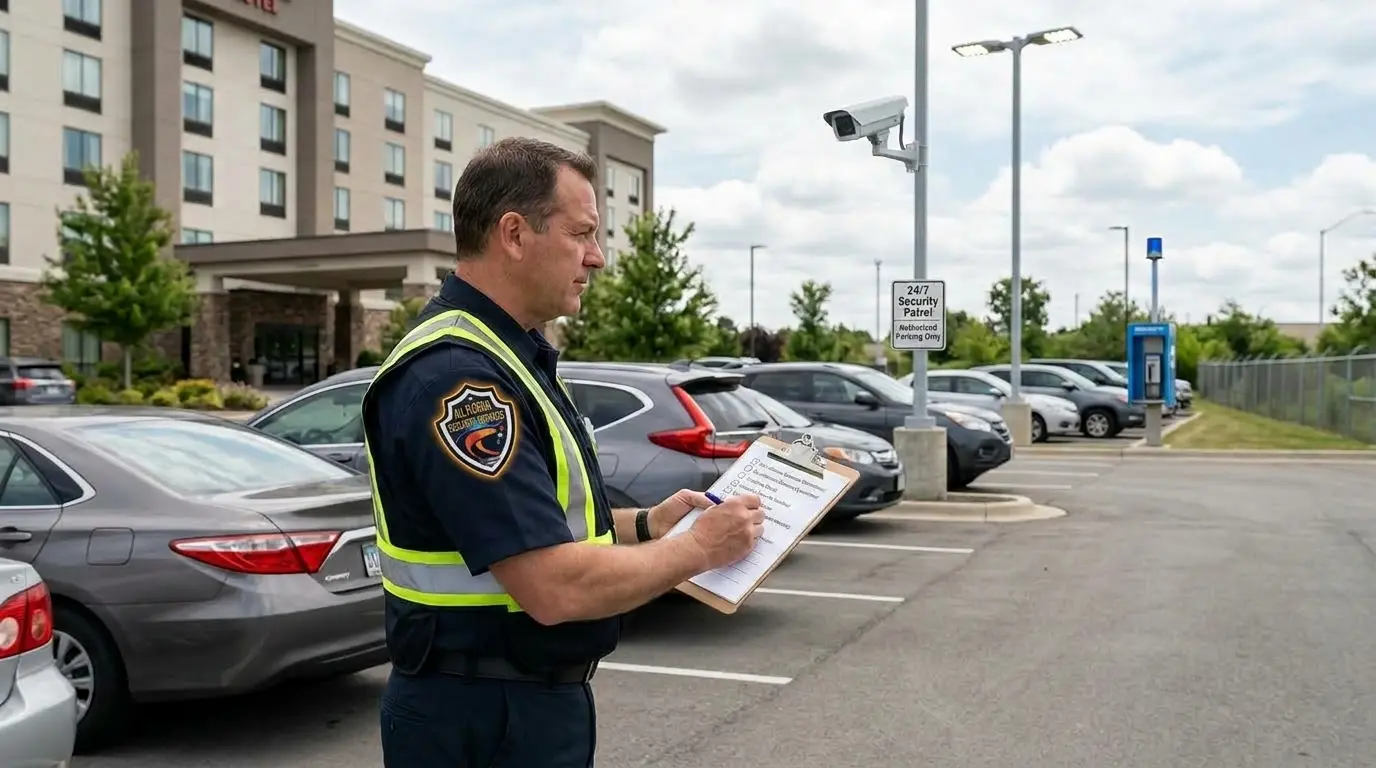
The perimeter is your first line of defense, and it is the first thing an inspector or auditor checks. You are more likely to miss lighting failures and unmonitored side entrances than camera outages, mostly because they are easy to overlook during daylight walkthroughs.
- Is the main entrance under continuous camera coverage with a clear sightline for front-desk staff?
- Are side and rear entrances locked to outside access and openable only with staff credentials?
- Is every exterior walkway, stairwell, and parking area lit well enough to identify a face at twenty feet after dark?
- Are perimeter fences, gates, and landscaping free of gaps or blind spots that would let someone bypass a monitored entrance?
- Do vehicles entering gated or underground parking pass a visible checkpoint or camera before reaching guest areas?
Guest Room and Key Access Controls
Most guest-facing security failures trace back to key access, not the door hardware itself. A front-desk agent who reissues a room key without verifying ID has effectively handed over access to whoever asked for it. Electronic key systems should log every entry, since that log becomes the evidence trail if a complaint is filed later.
- Does the property require photo ID before issuing or reissuing a room key?
- Are lost or stolen keycards deactivated immediately and logged in the property management system?
- Do electronic locks record a time-stamped entry log that staff can pull on request?
- Are housekeeping and maintenance staff trained to knock, announce, and confirm before entering an occupied room?
- Are master keys stored in a controlled, logged location rather than carried loosely by multiple staff?
Surveillance and Physical Security Systems
The most common surveillance audit failure is a camera that points at the wrong angle, not recording, or storing footage for too short a window to matter after an incident. Test footage retrieval during the audit itself. Don’t just confirm the little red light is on.
- Are all camera feeds actively recording, with footage retained for at least the minimum period required by your insurer or franchise agreement?
- Can staff on shift retrieve footage from a specific camera and timestamp within a few minutes if asked?
- Are elevators, stairwells, loading docks, and pool areas included in camera coverage, not just the lobby?
- Are alarm systems — fire, intrusion, and panic — tested on a documented schedule rather than left untested until triggered?
- Is there a secondary power source or backup for surveillance and access-control systems during an outage?
Staff Training, Credentialing, and Vendor Access
Hardware only works if staff are trained to use it and know what to challenge. A hotel can pass every camera and lock check on paper and still fail an audit if front-line staff have never been drilled on what to do when something looks off.
- ID Verification Training: Front-desk and security staff know how to confirm guest identity before disclosing room numbers or reissuing access.
- Vendor and Contractor Logging: Every outside vendor signs in, is issued a visible badge, and is logged with arrival and departure times.
- Background Screening: New hires in guest-facing or master-key roles pass a criminal background check before starting.
- Suspicious Activity Reporting: Staff have a clear, low-friction way to flag concerns to a supervisor or security lead without navigating a complicated chain of command.
- Human Trafficking Recognition: Housekeeping and front-desk employees can name at least two behavioral indicators covered in their state-mandated training.
Emergency, Fire, and Hurricane Preparedness
Everyday fire and medical emergency readiness is one category. Florida’s added layer of hurricane and severe weather planning is another, and the two get blended together too often. Your evacuation plan needs a distinct hurricane annex, covering guest communication, structural shelter-in-place decisions, and staffing continuity. Storm season runs June through November, so this section of the hospitality security audit deserves a dedicated pre-season pass.
- Are fire alarms, sprinklers, and extinguishers inspected and tagged on the schedule required by the Florida Fire Prevention Code?
- Is the evacuation route posted in every guest room and confirmed clear of obstruction during the walkthrough?
- Does the property have a written hurricane plan covering guest notification, shelter-in-place criteria, and evacuation triggers?
- Is there a tested backup communication method for staff if cell towers or Wi-Fi go down during a storm?
- Are emergency supplies — water, first aid, backup lighting, radios — stocked and checked before each storm season?
Public Areas, Pools, and Event Spaces
Public areas carry a different risk profile because they mix guests, outside visitors, and staff in the same unmonitored space at once. A hotel bar on a busy weekend or a ballroom hosting an outside event needs visible staff presence. For larger bookings, properties may also consider special event security services as part of the event security plan.
- Are pool and fitness areas monitored and restricted to registered guests after posted hours?
- Is bar and restaurant activity actively supervised during peak hours, not just recorded on camera?
- Do event and conference spaces get a security review before large outside bookings, including whether added screening is needed?
- Are lost-and-found and guest complaint logs reviewed weekly for patterns that might point to an unaddressed risk?
Cybersecurity and Guest Data Protection
A hotel security audit checklist that only checks locks and cameras misses the property management system and the guest Wi-Fi network. This is where your guests’ financial and personal data lives. A notable share of hospitality businesses have already experienced a data breach at some point, and no property should assume it’s the exception.
- Is guest Wi-Fi segmented from the network running point-of-sale and property management systems?
- Are firewall and antivirus protections current on every device connected to hotel systems?
- Do staff receive periodic training on phishing attempts and suspicious link recognition?
- Are software and security patches applied on a defined schedule rather than left until a vendor flags an issue?
Shift Handover and Audit Documentation
This is the part most properties skip: turning the walkthrough into a record someone can act on and produce later. An audit with no paper trail is functionally the same as no audit if a claim ever goes to litigation.
- Is there a documented handover between shifts noting open concerns or incidents?
- Is a daily or weekly security log compiled and stored where management can retrieve it?
- Are failed checklist items assigned an owner and a resolution deadline, not just flagged and left open?
- Is the completed audit — photos, notes, and sign-off — stored in a format you could hand to an insurer or attorney if asked?
Florida-Specific Compliance Requirements Property Managers Can’t Skip
Florida Statute 509.096 requires every public lodging establishment to provide annual human trafficking awareness training to housekeeping and front-desk staff. New hires in those roles must complete training within 60 days of starting, and each employee must sign a dated acknowledgment kept on file for DBPR to request. Noncompliance carries a fine of up to $2,000 per day per property.
Every Florida hotel operates under a license from the Division of Hotels and Restaurants, and that license carries ongoing fire and life-safety inspection obligations under the Florida Fire Prevention Code. These inspections check the same items covered in the emergency preparedness section above — alarms, extinguishers, and exit access. A well-run internal audit serves as your license-renewal preparation.
Florida’s emergency management framework expects hotels to have a workable plan for guest safety during a declared storm event, including communication with local emergency services. This is the regulatory reason the hurricane planning item exists in the checklist above.
Florida courts hold property owners liable when a foreseeable security failure, such as a broken lock or an unlit walkway, contributes to a guest being harmed. A documented audit trail is one of the strongest tools a property has to demonstrate reasonable care if someone files a claim.
How Often Should a Florida Hotel Run a Security Assessment?
Run the full checklist quarterly, with a dedicated pre-season pass in May before hurricane season begins. A few situations should trigger an audit outside that normal schedule.
- After any reported theft, trespass, or guest safety incident
- Following a change in general manager or head of security
- Before and after major renovations affecting locks, cameras, or exits
- Ahead of a franchise inspection, insurance renewal, or DBPR license renewal
- At the start of hurricane season, independent of the regular quarterly cycle
Turning Audit Results Into a Repeatable Security Program
Assign one accountable owner (often a GM or security lead) responsible for scheduling the next audit before the current one is closed out. Digital inspection tools can timestamp photos and auto-generate reports, which matters most when an audit record needs to hold up months later in front of an insurer or in a legal claim. Treat the checklist as a living document: update it whenever a new risk, renovation, or regulation changes what the property needs to check.
Get Your Property Audited by Local Security Professionals
Running this checklist on your own gets you most of the way there, but a trained set of eyes can catch what daily familiarity misses. All Florida Security Services works with hotels and resorts across the state to conduct hands-on security assessments, staff training, and licensed guard placement built around Florida’s specific legal requirements.
Contact us to schedule a property assessment or talk through your next audit with our team.
Frequently Asked Questions
What is the difference between a hotel security audit and a hotel risk assessment?
A risk assessment identifies which threats matter most for a specific property based on location, size, and guest profile. A security audit tests whether the controls put in place to address those threats (locks, cameras, etc) are actually functioning. Most properties need both, run in that order.
Does Florida law require hotels to have armed security?
No. Florida law does not mandate armed security at hotels; staffing decisions are left to the property based on its own hotel security assessment and insurer requirements. What Florida does mandate is human trafficking awareness training under Section 509.096 for housekeeping and front-desk staff.
How long should a Florida hotel keep security camera footage?
Retention periods vary by insurer and franchise agreement, but many properties keep footage for at least 30 days, with longer windows for high-traffic areas. Check your specific insurance policy and franchise standards, since requirements differ by carrier and brand.
Who should conduct the hotel security audit — internal staff or a third party?
Internal staff can run the quarterly walkthrough, but an independent third-party assessment adds value annually or after a significant incident. A fresh set of eyes tends to catch procedural blind spots that staff have stopped noticing.
What happens if a Florida hotel fails to provide human trafficking training?
The Division of Hotels and Restaurants can impose a fine of up to $2,000 per day for noncompliance with Section 509.096. Properties should keep signed training acknowledgments on file, since DBPR can request them during a license review.