
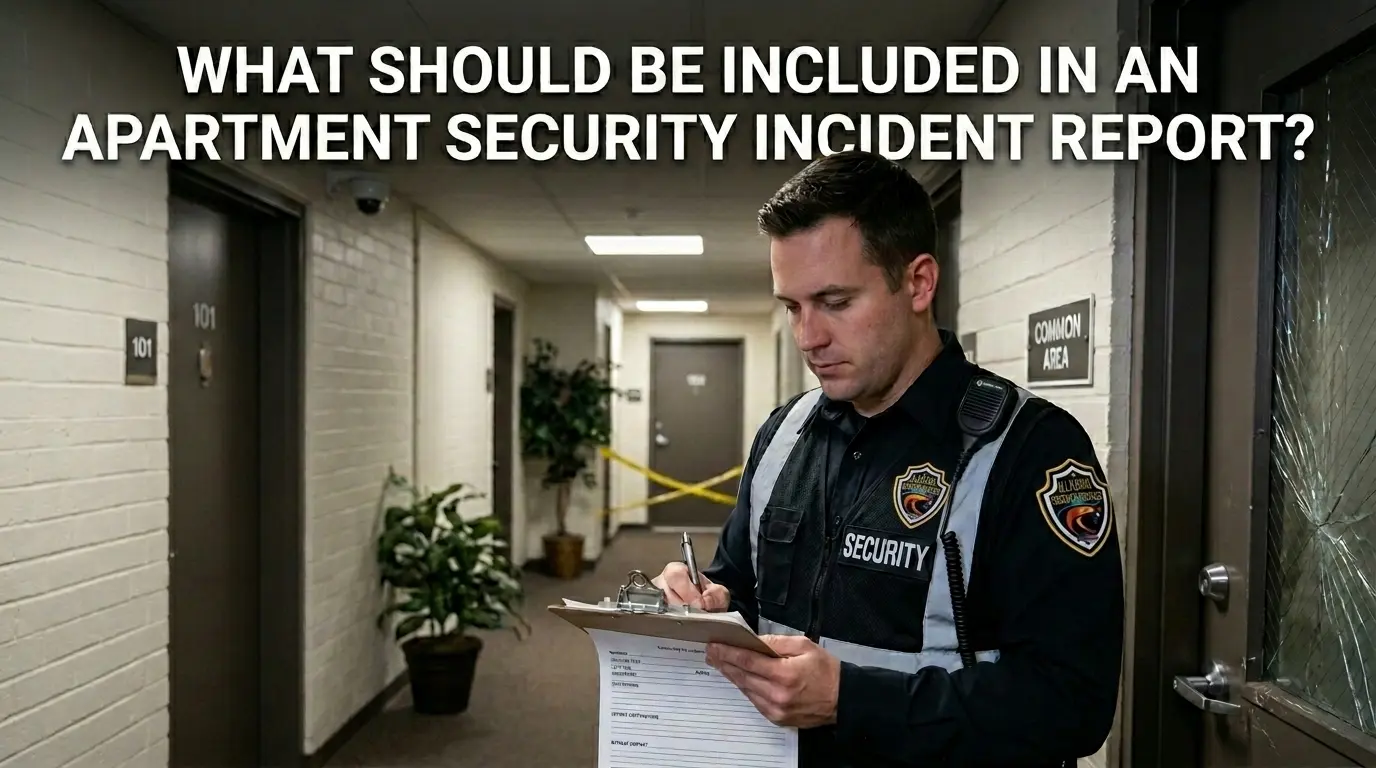
A complete apartment security incident report includes the details of everyone involved, a factual chronological narrative, the evidence collected, the actions taken, and the current resolution status. Trained, licensed residential security officers are best equipped to complete these reports accurately. Residential incidents carry higher stakes than a workplace report because evictions and resident safety can hinge on what is written down. This article breaks down every element your team needs to craft a professional report, the process for writing it, and a ready-to-use template.
What Is an Apartment Security Incident Report?
An apartment security incident report is a written, timestamped record created by a security officer or property staff member after something unusual happens on residential property. This covers theft, trespassing, medical emergencies, property damage, unauthorized access, or a policy violation. It documents both what the officer observed directly and what residents or witnesses reported, and how the situation was resolved.
Several people may read this report long after the incident occurred. Insurance adjusters, attorneys handling a liability or eviction case, law enforcement, and sometimes the resident named in the report will all rely on it. Because a resident’s tenancy or a legal claim can depend on this single document, write it as if a stranger with no context will read it.
Apartment security incident reports are written to cover either one or more of the following scenarios:
- A break-in, attempted entry, or reported theft from a unit, mailroom, or vehicle
- A resident or guest disturbance, altercation, or noise complaint escalation
- Unauthorized access through a gate, fob system, or propped door
- A slip-and-fall, medical emergency, or injury in a common area
- Vandalism or property damage to a unit, amenity space, or parking structure
- Any police, fire, or EMS response on the property
The 6 Core Elements Every Apartment Security Incident Report Must Include
No matter what triggered the call, a defensible apartment security report answers who, what, when, where, why, and how. The six sections below break down exactly what to capture for each one.
1. Incident Details and Report Identification
Every report needs a clear administrative header. This includes a unique report reference number and the date and time the incident occurred (which is not the same as when the report was written). This header is what makes an incident log searchable later. It also includes the specific unit or common-area location, the incident type or category, and a severity classification if your property uses one.
2. Persons Involved — Residents, Guests, Staff, and Witnesses
Document everyone connected to the incident with their role clearly labeled: resident, guest, visitor, witness, suspect, or responding staff. Include unit numbers for residents, contact information where permitted, and a physical description for anyone whose identity is unknown. Only record resident personal information to the extent your site policy and privacy obligations allow.
3. A Factual, Chronological Narrative
Describe the incident in the order it happened, using first-person language like I observed or I was notified. Keep your own observations separate from anything a resident or witness told you secondhand. This is where most incident reports fall apart, and it is the single most important habit a security officer can build.
Avoid: “The guy in the hallway was clearly causing trouble and scaring people.” Better: “At 11:42 PM, I responded to Unit 214 after two residents reported yelling in the third-floor hallway. I observed a male resident raising his voice at another resident outside Unit 217.”
4. Notifications and Actions Taken
Record everyone you notified, be it the property manager, police, fire, or EMS. Then document exactly what the responding officer or staff member did: denied access, requested ID, called for medical assistance, secured a door, or escorted an individual off the property. Actions without notifications, or notifications without actions, both leave gaps a reviewer will notice.
5. Evidence and Supporting Documentation
At an apartment community, evidence usually means gate or fob access logs, CCTV footage, photos of damage, package-room or mailroom logs, and written witness statements. Note where each item is stored and who has custody of it. Physical evidence and surveillance footage mean nothing if no one can locate them six months later.
6. Resolution, Status, and Follow-Up
State the condition of the scene and the status of the incident at the time you are writing: resolved, under investigation, referred to police, or pending management review. Also, name a target date for any follow-up action, whether that is a lease violation notice, a maintenance repair, or a policy change. A report without a resolution status is an open question, not a closed file.
How to Complete a Residential Security Incident Report: The Reporting Process
The knowledge of what to include only helps if your team follows the same reporting process every time. Here is a step-by-step sequence you can train any officer on, regardless of their experience level.
Step 1 — Respond Before You Write
Handle the situation first. Safety and immediate response always come before paperwork, and no report is worth delaying a medical call or a security response. That said, brief notes or a few phone photos taken in the moment make the report you write later far more accurate.
Step 2 — Gather Facts Before Drafting
Collect everything available before you start writing. That can include access logs, witness names, camera locations, etc. Officers who write and investigate at the same time tend to produce reports with gaps and contradictions. Treat fact-gathering as its own step, not something you do mid-sentence.
Step 3 — Write the Report Same-Day
Complete the report the same day as the incident, ideally within a few hours. Memory of specific details like what a resident exactly said fades fast. A report written two days later rarely holds up as well as one written the same night.
Step 4 — Review, Sign, and Submit
Before submitting, confirm that names, unit numbers, and times all match your notes. Make sure that no field was left blank without an explanation. Serious incidents should get a supervisor countersignature before they are filed or shared with ownership. This last check double checks your own work before someone else has to.
Run through this final proofread pass before you submit your report:
- Accuracy: Do the names, unit numbers, and times match your original notes?
- Completeness: Is every field filled in? If no info is available, mark that field as “not obtained.”
- Objectivity: Have you clearly distinguished the opinions and assumptions from observed facts?
- Consistency: Does the incident timeline match your evidence from CCTV timestamps and access logs?
Apartment-Specific Details a Generic Incident Report Misses
Tie every incident to a specific unit number, and note whether the resident involved has a documented history of similar incidents. A pattern of behavior can affect their lease renewal or support an eviction filing. This single detail about the unit and lease context is often the difference between a report that closes an issue for good and one that reopens it.
Document exactly how the person involved got onto the property: a resident-issued fob, a propped gate, tailgating behind another resident, or an entry through the guest and visitor log. Access control failures are among the most common liability points at apartment communities, and unauthorized access rarely happens the same way twice.
Property managers should review the HOA Security RFP checklist for documentation standards that apply across residential properties. Documentation also shifts depending on where the incident happened. A leasable private unit requires added sensitivity and consent before entering or photographing inside, while a shared amenity space like the pool, gym, parking garage, or mailroom allows more routine documentation without those same privacy concerns.
Apply these resident-privacy safeguards whenever you write a report:
- Record only the personal information necessary to document the incident, not extra details about a resident’s lifestyle or visitors
- Store photos and footage according to the property’s data-retention policy. Do not use your personal device for this purpose
- Share the report only with parties authorized to receive it — never post details or images to personal social media
Appropriate Language for Writing an Objective Security Officer Report
Word choice determines whether a report holds up in an injury claim or an eviction hearing. The core rule is simple: describe what you saw, heard, or did, and attribute anything secondhand to the person who said it. Use terms like “the resident stated” to distinguish a claim from a confirmed fact. Unsupported conclusions about intoxication or motive are one of the fastest ways a security officer report gets discredited.
| Avoid (Opinion/Vague) | Better (Objective/Specific) |
| “The resident was drunk and out of control.” | “The resident raised his voice, struck the leasing office counter twice, and had slurred speech.” |
| “There was a mess in the hallway.” | “Approximately eight boxes and a mattress blocked roughly half of the third-floor hallway near Unit 312.” |
| “The guest seemed suspicious.” | “An unidentified individual attempted to follow a resident through the gate without badging in and could not name a resident they were visiting.” |
Apartment Security Incident Report Template
You can copy the fields below directly into a paper form or a digital incident-reporting system. Keep the field order consistent across every report your team files, so incidents can be compared and audited later.
Incident Details
- Report reference number
- Date/time of incident and date/time report was written
- Property name, unit number, and specific location (e.g., “Parking Garage, Level 2, near Elevator B”)
- Incident type/category and severity level
Persons Involved
- Name, unit number (if resident), and role (resident, guest, witness, suspect, staff)
- Contact information, where available and permitted
- Physical description if identity is unknown
Narrative
- Chronological, first-person account of what was observed
- Actions taken and by whom
- Statements attributed to specific individuals
Evidence
- CCTV camera reference and time range
- Photos/videos taken and where stored
- Access-log or fob-entry records
- Witness statements collected
Response
- Who was notified (manager, on-call staff, police, EMS) and when
- Reference or case number provided by responding agency
Resolution
- Condition of the scene/incident at time of writing
- Follow-up actions required, responsible party, and deadline
- Officer sign-off: name, role, date/time completed
- Supervisor countersignature (for serious incidents)
Common Mistakes That Weaken an Apartment Security Report
Most weak reports fail for the same handful of reasons, and nearly all of them are avoidable by following a consistent writing process.
- Writing it too late: A report written two days later cannot match what a same-day report would capture.
- Guessing at motive or condition: Stating a resident was on drugs or was trying to break in without direct evidence turns an observation into an unsupported accusation.
- Leaving the unit number vague: Writing ‘third floor’ is not the same as “Unit 312,” and the difference matters if the report is later used in an eviction or claim.
- Skipping the follow-up section: A report that only describes what happened, without stating what happens next and who owns it, leaves the incident effectively unresolved on paper.
- Inconsistent formats across officers: When every guard uses a different writing structure, repeat patterns across units become nearly impossible to spot.
Building a Consistent Incident Reporting Process Across Your Property Team
Individual reports are only as useful as the system behind them. If different officers or leasing staff use different formats and levels of detail, the resulting records become hard to compare. You cannot use them to spot a repeat visitor or a recurring access-control gap.
Consistency comes down to three things:
- Property managers can apply similar rigor using a patrol log evaluation checklist for routine documentation.
- A standardized template used by every shift
- Clear training on objective language
- A submission process that makes filing a complete report easy.
Whether that is a shared form or a digital incident-reporting system, the goal is the same — every officer documenting incidents the same way.
Get Trained, Documented Security Support for Your Property
Strong incident reports start with well-trained officers who know what to observe and how to write it down. All Florida Security Services provides licensed security guard services and professional security training across Florida, helping apartment communities build a smooth reporting process. Reach out to discuss guard placement, officer training, or a documentation system tailored to your property.
Frequently Asked Questions
What should be included in an apartment security incident report?
Include incident details (report number, date/time, unit/location) and everyone involved, with a factual chronological narrative. Also record the evidence collected, notifications and actions taken, and the resolution or follow-up status.
Who writes a security officer report at an apartment community?
The on-duty security officer or leasing/property staff member who witnessed or responded to the incident writes the report. Serious incidents are often countersigned by a supervisor or property manager.
How soon after an incident should the report be written?
Write it the same day, ideally within a few hours, while details and witness recollections are still accurate.
Can a resident request a copy of an incident report filed about them?
This depends on local landlord-tenant law and the property’s own policy; residents should be directed to management rather than given a copy directly by the reporting officer.
What’s the difference between an apartment security incident report and a damage report?
An incident report documents what happened and who was involved in the event. While a damage report focuses specifically on the physical harm to the property, such as a flooded unit’s ruined flooring.