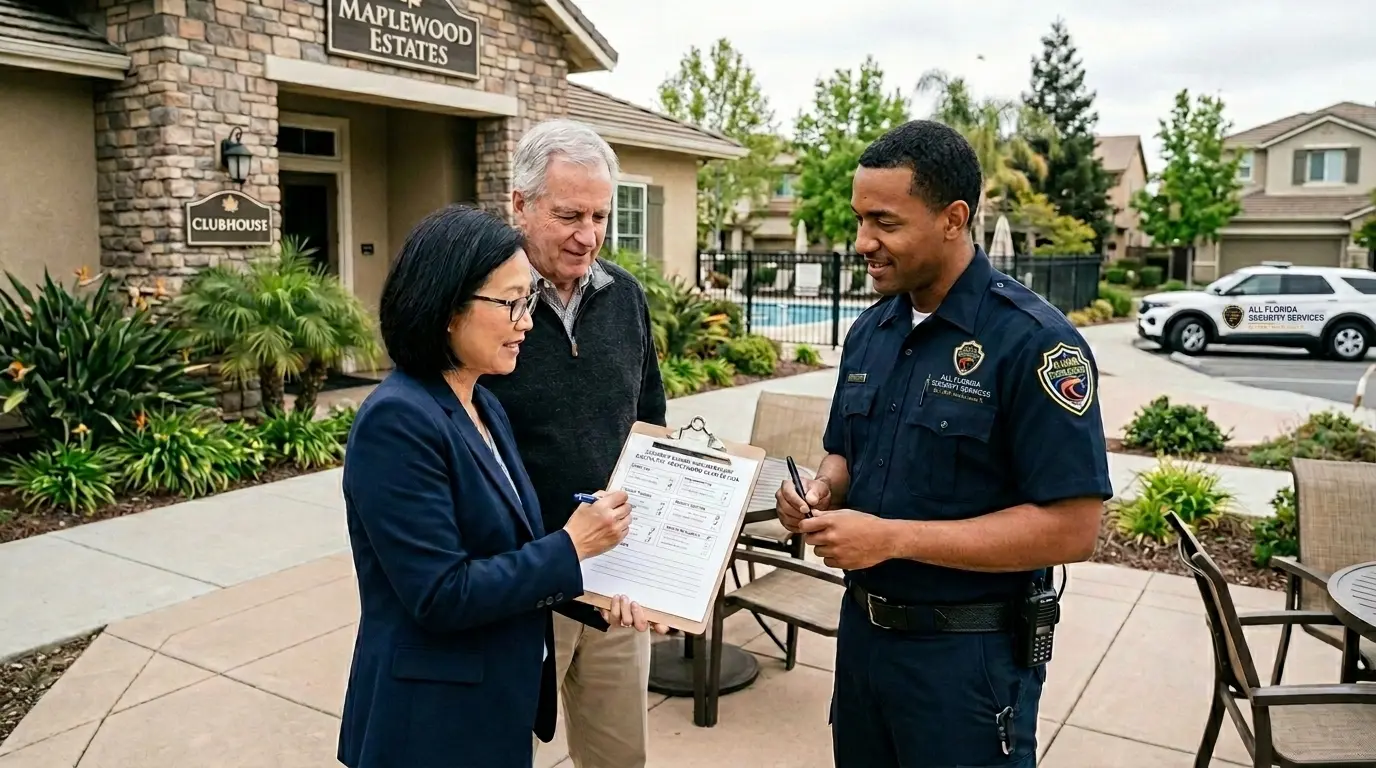
Most HOA boards sign a security contract, meet the guards once, and assume everything will run smoothly from there. It usually doesn’t work that way. Guard performance drifts over time, and without a clear way to measure it, boards end up reacting to complaints instead of catching problems early.
A structured security guard performance checklist gives boards a repeatable way to evaluate their contracted professional residential security guards. An efficient checklist covers patrol consistency, access control, incident response, and communication — the categories covered in detail below.
Why HOA Boards Need a Formal Security Guard Performance Checklist
Most HOA boards judge their security vendor based on a mix of gut feeling and the occasional resident complaint. Nobody writes anything down, and nobody tracks it over time. That approach leaves the board with no evidence to point to if a serious incident happens or a resident files a liability claim questioning the guard service.
Guard performance means more than a body standing at the gate. It determines whether the guard follows the community’s security protocols correctly. It includes how they respond when something goes wrong, how clearly they communicate with residents and management, and whether they actually know how to operate the access control systems installed at the property. A guard can look pretty sharp and still fall short in every one of these areas.
From Anecdote to Accountability
A recurring HOA security guard checklist gives the board hard data to reference. It turns vague impressions into specific, dated findings the security company cannot easily dismiss. It becomes the board’s main tool for holding the vendor accountable to what the contract actually promises.
Performance problems tend to cluster into a handful of recurring issues once boards start paying attention:
- Whether guards actually complete their patrol routes on schedule.
- How accurately they log visitors, vendors, and incidents.
- How they respond and communicate when something actually goes wrong.
- Whether they know the community’s rules well enough to enforce them fairly.
The Core Security Guard Performance Checklist
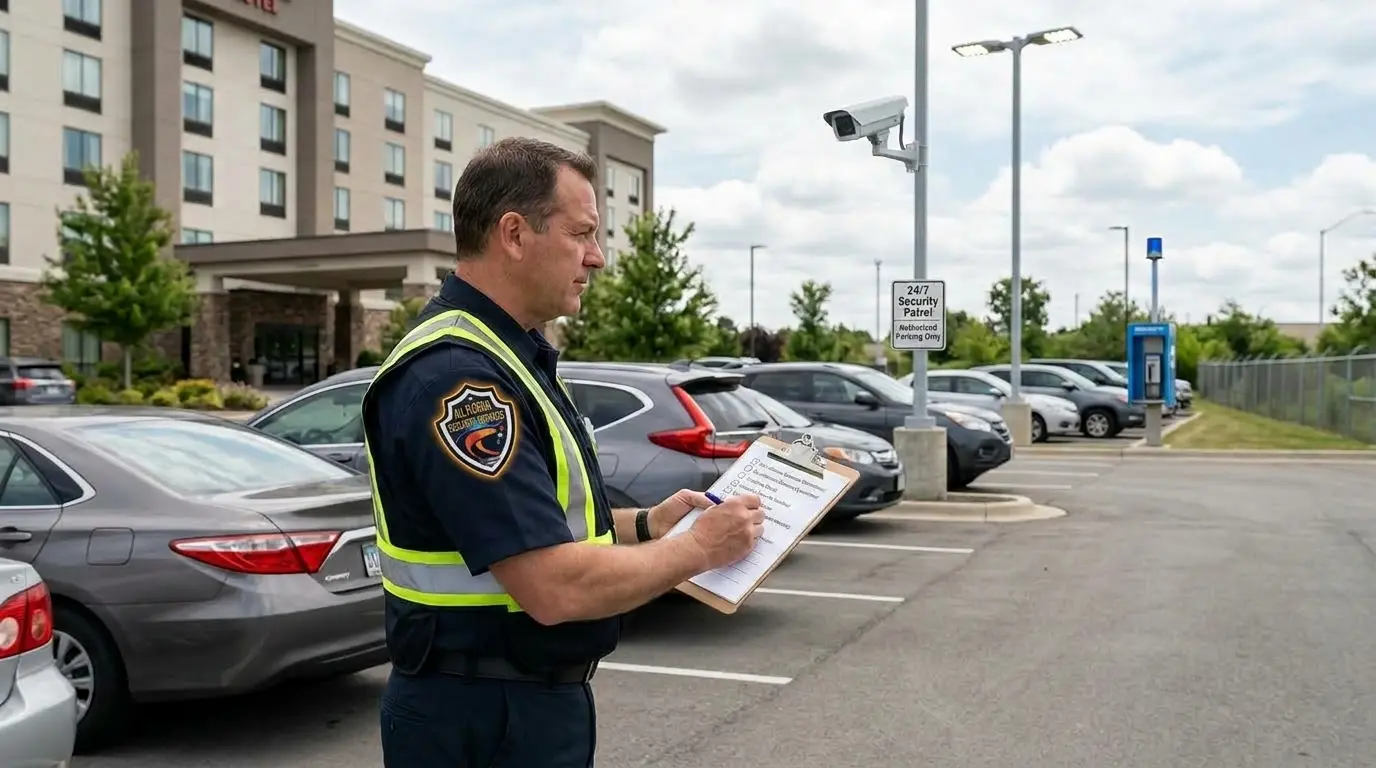
Here is the actionable part. These eight categories give a board or community manager something scorable to use during a monthly review:
Uniform, Presentation & Professional Conduct
A guard’s appearance and demeanor shape how residents judge the entire community’s safety standards, whether that’s fair or not. Sloppy presentation often tends to show up alongside other lapses, like skipped patrols or careless reporting. Checking this first sets the tone for the rest of the review.
- Uniform is clean, properly fitted, and matches the contracted dress standard.
- ID badge is visible and current.
- Guard remains courteous and professional with residents, guests, and vendors.
- Guard is not distracted by a personal phone while on post.
Patrol Consistency & Gate or Perimeter Coverage
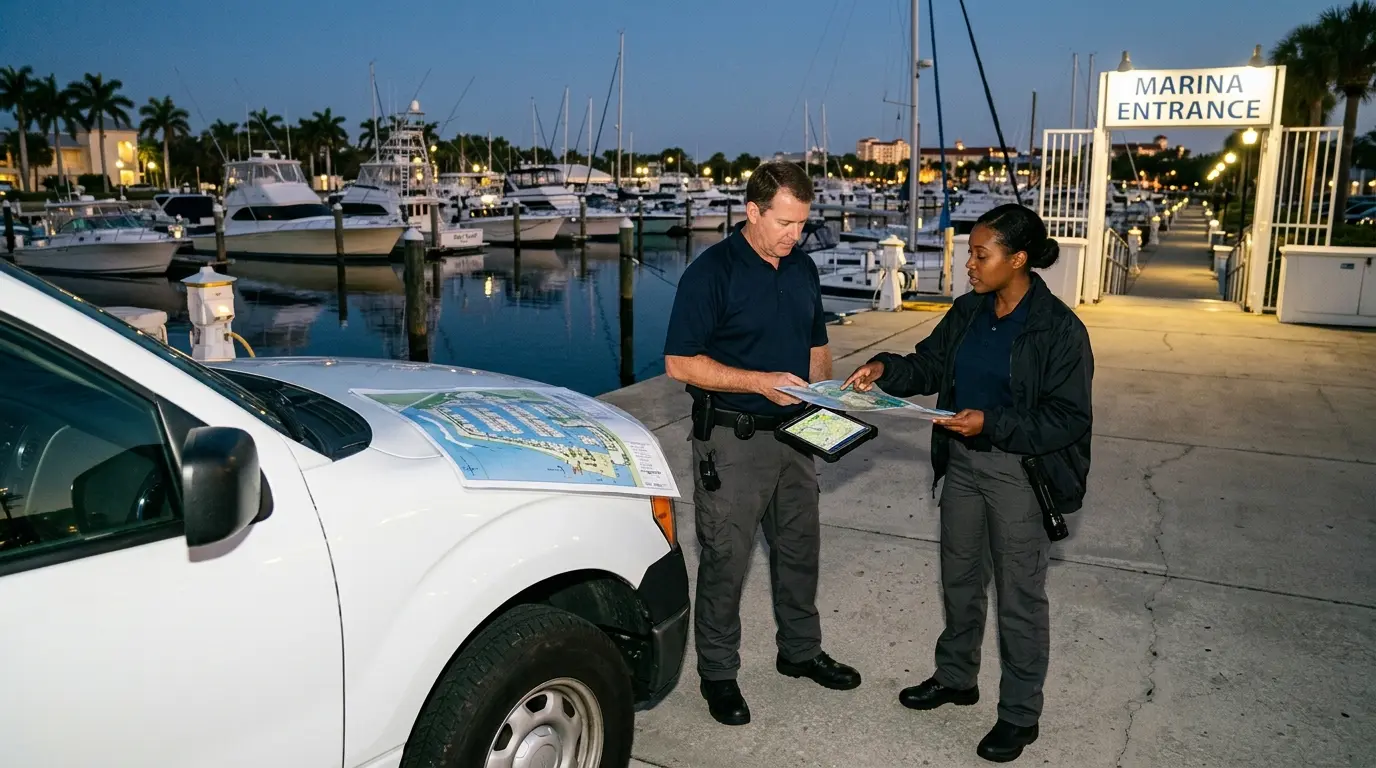
Consistent, unpredictable patrol timing deters incidents in a much more effective way than a stationary guard at the gate. A guard who walks the same loop at the same time every night becomes predictable, and predictable patrols are easy to work around.
- Patrols follow the contracted schedule and cover every assigned zone, including amenities and parking lots.
- Entry points, gates, and common area doors are checked and secured each round.
- Patrol timing varies enough to avoid predictable blind spots.
- GPS or digital patrol logs (if applicable) match the guard’s reported activity.
Visitor Log Accuracy
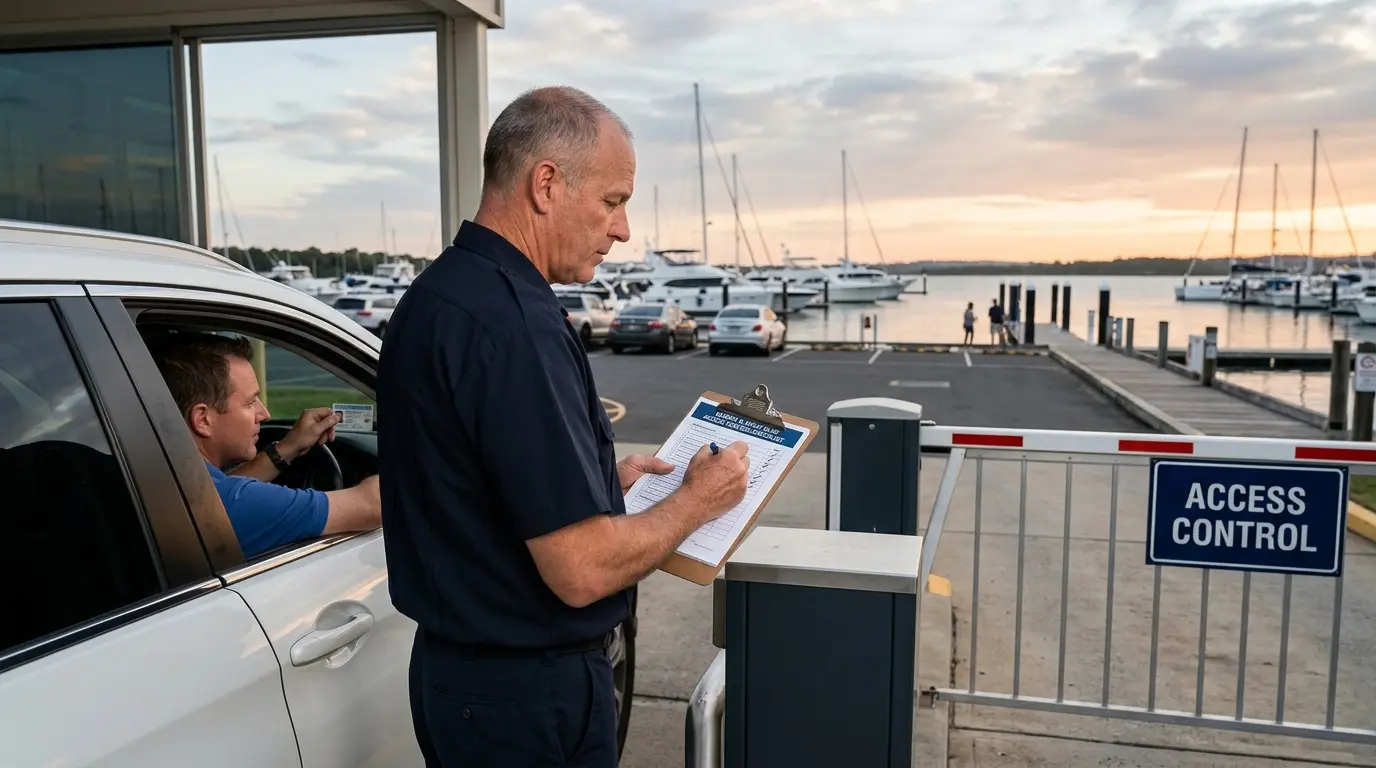
Gate logs and visitor records are often the first documents pulled during a liability claim or a dispute between residents. Small errors here carry outsized legal weight later, which is exactly why access control belongs at the center of any security guard assessment a board runs.
- Visitor Verification: Confirms identity and destination before granting entry.
- Vendor Compliance: Checks vendor credentials against the community’s approved list.
- Log Completeness: Records every entry and exit with legible, timestamped detail.
- Gate Equipment Checks: Tests call boxes, keypads, and barrier arms for proper function.
Incident Response & Emergency Preparedness
How a guard reacts in the first sixty seconds of an incident often matters more than any policy written down on paper. Boards should specifically probe how guards would handle fire, medical emergencies, trespassing, and disturbances between residents.
- Guard can state the correct escalation steps for fire, medical, and security threats without hesitation.
- De-escalation techniques are used appropriately with agitated residents or trespassers.
- They know first-aid basics and first-aid kit locations.
- They have memorized emergency contacts and evacuation routes.
Incident Reporting Quality
Report quality drives board decision-making more than boards realize. A vague or incomplete incident report leaves the board unable to act, unable to file an insurance claim properly, and unable to defend the community if a resident’s claim follows. This is where a genuine security officer performance review earns its keep.
- Report Accuracy: Documents who, what, when, and where without vague language.
- Timeliness: Submits reports the same shift, not days later.
- Escalation Clarity: Notifies management or the board promptly for serious incidents.
- Resident Follow-Up: Communicates next steps to affected residents when appropriate.
Equipment & Technology Proficiency
Owning security cameras and access software does not help much if the guard on duty cannot actually operate them. A guard should be able to pull footage, run reports, and troubleshoot basic issues without calling a supervisor for every step. Technology nobody understands is a wasted line item in the security budget.
- Radios, flashlights, and issued devices are functional and carried at all times.
- Guard can pull up and interpret live or recorded camera footage when asked.
- Alarm systems are tested per schedule and false alarms are logged correctly.
- Digital patrol or reporting apps are used consistently, not skipped for paper shortcuts.
Knowledge of HOA Rules, Post Orders & Community Policies
HOA guards need to enforce rules that generic security training does not cover, such as pool hours, parking restrictions, and guest policies specific to that one community. A guard unfamiliar with these post orders cannot enforce them consistently. Inconsistent enforcement is what generates resident complaints and disputes at board meetings.
- Post Order Familiarity: Can explain the community’s specific rules and enforcement limits.
- Amenity Rule Enforcement: Applies pool, clubhouse, and parking policies evenly across residents.
- Escalation Boundaries: Knows which rule violations to handle directly versus refer to management.
Training, Certifications & Continuing Education
A valid security license does not guarantee current skills. Boards should confirm ongoing guard training happens on a set schedule. Recent drills and refresher courses are the concrete proof points worth asking for.
- State licensing and certifications are current and on file with the vendor.
- Guard has participated in recent fire, evacuation, or emergency drills.
- Guard can describe recent updates to protocols or post orders.
- Ongoing training hours meet the vendor’s contracted commitment.
How to Conduct a Security Guard Performance Evaluation
Checking boxes is only half the process. Boards also need a repeatable way to run the review itself, so results stay consistent no matter who on the board happens to be doing the evaluating that month.
Choose a Simple, Consistent Rating Scale
A basic four-point scale works well for volunteer boards: Outstanding, Satisfactory, Needs Improvement, and Unsatisfactory. Keeping the scale simple means ratings stay consistent across different board members and different review periods, without anyone needing formal HR training to fill out the form correctly.
Set a Recurring Review Cadence
Pair monthly informal spot-checks with a formal quarterly or semi-annual review. Spot-checks catch problems early, while the formal review creates the documented record the board actually needs. Consistent timing is what turns isolated impressions into visible patterns worth acting on.
Combine Direct Observation with Resident Feedback
Paperwork only tells part of the story. Board members should occasionally observe guards on-site instead of relying entirely on logs and reports. It also helps to gather informal feedback from residents who interact with guards every day, since they often notice details a monthly walkthrough would miss.
Cross-Check Logs Against Camera and Access Data
Comparing a guard’s written patrol logs against camera timestamps or access control records catches discrepancies that self-reporting alone would never reveal. If a log says a gate was checked at 2 a.m. but the camera shows otherwise, that gap matters, and it’s worth flagging before it becomes a pattern.
Document Findings and Share Them with the Vendor
Every evaluation should end with a written summary sent to the security company’s supervisor. This creates a paper trail the board can point back to if performance issues continue, and it puts the vendor on notice that the board is paying attention.
HOA Board Security Oversight: Turning Evaluations into Contract Accountability
An evaluation that sits in a drawer doesn’t do much good. The real value shows up when boards fold those findings into how the community is actually governed and how the vendor relationship is managed going forward.
Board members should incorporate the HOA Security RFP checklist when establishing performance expectations. A documented evaluation history gives the board concrete grounds to request corrective action, renegotiate contract terms, or terminate the agreement if needed. That is a very different conversation than walking into a vendor meeting with subjective impressions and no paper trail to back them up.
Red Flags That Signal It’s Time to Escalate
Not every low score requires an immediate response, but certain patterns should move the board from routine feedback to formal action.
- The same deficiency appears on three or more consecutive evaluations without improvement.
- Boards should also consider mobile patrol vs gate guard decisions when evaluating overall security effectiveness.
- Patrol logs repeatedly don’t match camera or access control timestamps.
- Residents report the same complaint about a guard more than once.
- Incident reports are consistently late, vague, or missing entirely.
- Licensing or training records lapse without the vendor proactively flagging it.
Work With a Security Team That Welcomes Oversight
All Florida Security Services trains and staffs licensed security officers who understand HOA communities, from gatehouse procedures to post orders built around your governing documents. Whether your board needs a new security provider or ongoing guard training, our team is ready to talk. Visit our website to request a consultation and see how a properly trained, well-supervised guard team can strengthen your community’s safety and security.
Frequently Asked Questions
How often should an HOA evaluate its security guards?
Run monthly informal spot-checks paired with a formal documented review every quarter. Communities with a history of incidents should increase that frequency for closer oversight.
Who on the board should be responsible for evaluations?
A security or safety committee, or the community manager, should handle evaluations rather than the full board. This keeps the process consistent instead of becoming an inconsistent, rotating duty.
Can a poor evaluation be grounds to change security vendors?
Yes. Documented, dated evaluations showing repeated deficiencies give the board a defensible basis to request corrective action or terminate the contract per its terms.