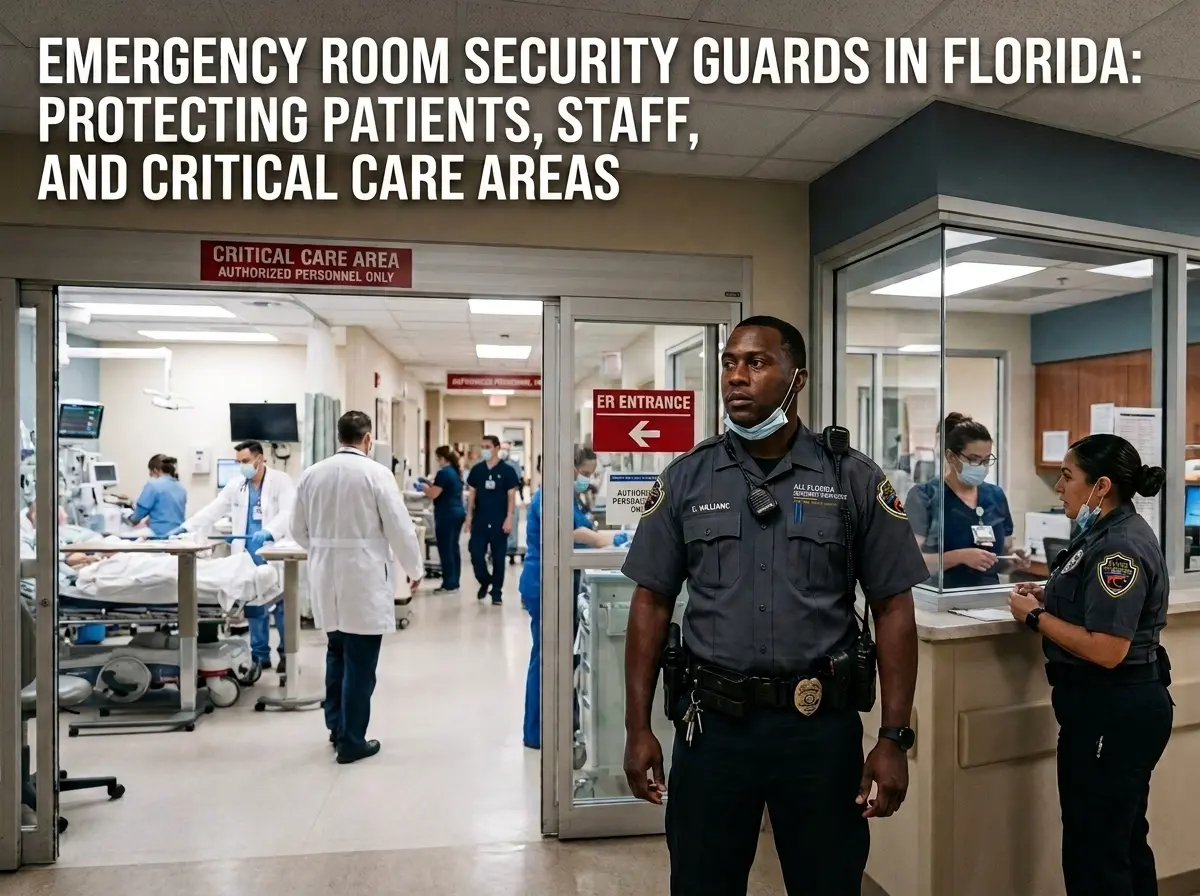
Florida’s emergency departments never sleep. Every hour of every day, hospitals across the state receive patients in crisis, from physical trauma to psychiatric distress. With them are their family members under enormous emotional strain. In that environment, the line between safe and dangerous can shift in seconds. For the broader statewide framework behind rapid deployment, guard roles, and disaster coverage, review our complete guide to emergency security guard services in Florida
Let’s uncover why professional emergency room security guard services are absolutely necessary for any Florida hospital.
The Volatile Reality of Florida Emergency Departments
Emergency departments encounter highly unpredictable situations compared to other areas of a hospital. Understanding that volatility is the first step toward managing it.
The 24/7 Red Zone
Emergency departments operate as the primary unrestricted entry point into a hospital around the clock. Anyone can walk through those doors, and many do. That open access exposes medical staff to all kinds of individuals. Patients arrive under the influence of narcotics, already engaged in aggressive behavior. It creates an unpredictable, high-risk floor that clinical teams must manage alongside the actual act of delivering care.
The De-escalation Challenge
Nurses and doctors are trained to diagnose, treat, and heal. That is their mandate and their skill set. We cannot expect those same clinicians to absorb threats or aggression while simultaneously managing a medical emergency. It not only places patient outcomes at risk, but also creates moral injury among care providers. It also exposes the hospital to serious liability when incidents escalate.
The primary threats in an unsecured emergency department include:
Unrestricted public access points with minimal initial screening
Volatile patient family members and visitors reacting to high-stress, traumatic situations
Acute psychiatric cases, including individuals brought in under Florida’s Baker Act provisions
Severe Legal and Financial Liabilities of an Unsecured ER
There are consequences of failing to secure an emergency department. Florida law and federal regulatory frameworks together create a serious exposure for hospitals that treat physical security as secondary.
Florida HB 825 and Enhanced Penalties
Florida House Bill 825 (2023) changed the legal landscape for hospital security in a significant way. The law reclassifies assault or battery committed against hospital personnel, elevating what was once a misdemeanor into a third-degree felony offense. Hospitals now carry a legal duty to ensure protection with measurable physical safety measures, including hospital security guards.
Staff Burnout
Inadequate security is a direct driver of nursing turnover. When emergency department staff face repeated threats without meaningful protection, fear compounds over time. That sustained fear accelerates burnout, triggers early departures, and drives up recruitment and retraining costs significantly. The moral injury that follows persistent exposure to workplace violence is well-documented in clinical literature.
Regulatory Non-Compliance
Hospitals operating without documented, functional security protocols face scrutiny from multiple directions at once. OSHA’s General Duty Clause holds employers responsible for known workplace hazards, including violence. The Joint Commission has issued specific standards for managing patient and visitor aggression. When a preventable assault occurs on an unsecured floor, the resulting negligent security lawsuit can carry seven-figure damages.
Role of an Emergency Room Security Guard
A trained security team for healthcare environments does far more than stand near the entrance. The right deployment creates a layered protective presence that supports clinical care, manages behavioral crises, and keeps access boundaries intact.
1. Rapid Crisis Intervention and Physical De-escalation
A trained emergency department security guard brings a specialized skill set to behavioral emergencies. These officers are certified in verbal de-escalation and physical restraint techniques that allow them to manage combative patients without causing injury or interrupting active medical care. That distinction matters. Every emergency response they handle is one that a nurse or physician does not have to.
The visible presence of guards for emergency room security creates an immediate psychological deterrent. When patients and visitors see a uniformed, trained officer in the clinical space, the threshold for acting out rises considerably. That deterrent effect frees doctors and nurses to remain fully focused on clinical intervention rather than managing their own physical safety.
2. Access Control Responsibilities
Security guards emergency room teams manage one of the most critical boundaries in any hospital: the line between the public waiting room and the secured clinical treatment area. Officers posted at triage control points verify authorization before allowing any non-patient movement into active care corridors. That boundary is the first and most reliable defense against unauthorized entry to restricted areas.
Controlling visitor flow in a busy emergency department requires consistent protocol. Security officers handle badging, monitor visitor capacity in individual treatment rooms, and enforce time and access limitations that protect patient privacy and prevent the overcrowding that often precedes confrontations. Visitor management is not just a courtesy; it is an active risk-reduction function.
3. Baker Act and Psychiatric Patient Monitoring
Involuntary Admission Custody
When a patient is brought in under Florida’s Baker Act for involuntary psychiatric examination, the security role becomes especially precise. Officers must maintain continuous, non-invasive surveillance to prevent patient elopement, protect staff from unpredictable behavioral escalations, and ensure the patient does not pose a self-harm risk during the intake and stabilization period. This requires calm, professional judgment — not a reactive or aggressive posture.
Maintaining Clinical Dignity
Effective security protocols in behavioral health situations must align with the clinical care plan. Guards coordinate directly with nursing staff and treating physicians to ensure that monitoring and physical proximity respect the patient’s rights and support — rather than interfere with — active psychiatric care pathways. Security and clinical staff work as a single, coordinated team in these situations.
Armed vs. Unarmed Officers in the Emergency Department
Choosing the right type of security officer for each area of an emergency department is not a one-size-fits-all decision. Hospital administrators and clinical operations directors should evaluate the specific risk profile of each zone before selecting their security model.
Sourcing the Right Security Tier
Florida healthcare facilities have access to multiple security personnel classifications, each suited to a different operational role. The key is matching the guard’s training and authorization level to the realistic threat environment of the area they are assigned to protect.
| Guard Classification | Core Technical Competencies | Ideal ER/Hospital Application |
| Unarmed Security Officer (Class D) | Verbal de-escalation, patient monitoring, access control, and visitor credentialing | Waiting room presence, triage assistance, and Baker Act patient observation |
| Armed Security Officer (Class G) | Active threat mitigation, high-impact perimeter deterrence, and lethal/non-lethal tactical response | Main public entrance security, trauma bay perimeters, and night-shift parking lot patrols |
| Mobile Patrol / K9 Units | Large-scale perimeter sweeps, parking garage security, and rapid response to secondary hospital entrances | Multi-wing healthcare campuses, hospital helipads, and external loading docks |
Note: Guards for emergency room security require specialized healthcare training. General security personnel must receive supplementary education on HIPAA privacy laws, Joint Commission standards, and clinical empathy before being deployed to an active medical floor.
Selecting Localized Healthcare Security Services in Florida
Florida’s Chapter 493 of the Florida Statutes establishes strict licensing requirements for security agencies and their officers. Any firm providing emergency department security guard services in the state must hold an active Class B Security Agency license and ensure every officer in deployment carries current, verifiable individual certification. Administrators should request proof of licensure before any officer steps onto a clinical floor.
Effective healthcare security guards in Florida understand how to integrate with county sheriff’s offices, local police dispatch systems, and regional emergency management frameworks. That local coordination is critical when an incident requires rapid outside response.
Unique advantages of partnering with a local, specialized Florida hospital security provider include:
Local LE Coordination: Fast dispatch integration with county sheriffs and local municipal police departments
Joint Commission Alignment: Deep familiarity with localized safety audits, active shooter drills, and healthcare emergency preparedness criteria
Cultural Competence: Guards trained to handle diverse regional demographics, multi-lingual patient bases, and coastal emergency scenarios
Work With a Florida Security Team Built for Healthcare
All Florida Security Services provides licensed, healthcare-trained security personnel specifically equipped for the demands of Florida’s emergency departments. Our officers understand clinical environments and coordinate directly with your clinical team members from day one. We deploy Class D and Class G officers, and our mobile patrol units are available for larger campuses requiring perimeter coverage beyond the ER.
If your facility is evaluating its current security posture or preparing for a Joint Commission review, contact All Florida Security Services to discuss a site-specific security risk assessment. We serve hospitals, trauma centers, and behavioral health facilities across Florida.
Visit our website or call directly at (772) 595-5335 to connect with our ER and medical facility security team.
Frequently Asked Questions
Can an emergency room security guard physically restrain a patient?
Yes, but only under direct order from a physician or registered nurse, using approved medical restraint protocols designed to protect patient safety and prevent self-injury during intervention.
How does Florida HB 825 protect emergency room staff?
It increases criminal penalties for assaulting hospital personnel and on-duty security officers, reclassifying physical battery against healthcare workers as a felony-level offense under Florida law.
What is the recommended ratio of security guards to emergency department beds?
Ratios vary based on local risk assessments, but high-volume Florida trauma centers typically maintain at least two dedicated security officers stationed in the ER at all times.