

A property manager opens her inbox and sees it: last night’s patrol log, marked complete, every checkpoint checked off. Then a tenant calls about a side door that has been propped open since the night before. The log said everything was fine, but the building told a different story.
That gap is the whole problem with patrol log review. A completed log and a protected property are not the same thing. One is paperwork and the other is what you are actually paying for. This post gives property managers a repeatable framework for patrol log review, so they can catch gaps before residents or owners find them first.
What Counts as a Security Patrol Log (And Why Property Managers Should Actually Read It)
A security patrol log is the routine, time-stamped record a guard creates while checking assigned areas during a shift. It covers doors, lighting, common spaces, parking, and any other checkpoint written into the post orders. A single entry doesn’t tell you much on its own. The real value lies in the pattern across entries, shift after shift, week after week.
Many property managers treat patrol logs as a compliance formality, something to file and forget once it lands in the inbox. That habit turns a useful tool into a rubber stamp. With a careful review, you can turn a log from a simple record that “someone was here” into an early-warning system for problems building up on the property.
A well-reviewed log should tell a property manager:
- Whether every assigned area was actually checked, not just marked complete
- Whether conditions are improving, staying flat, or getting worse over time
- Whether the guard team is following the property’s specific post orders
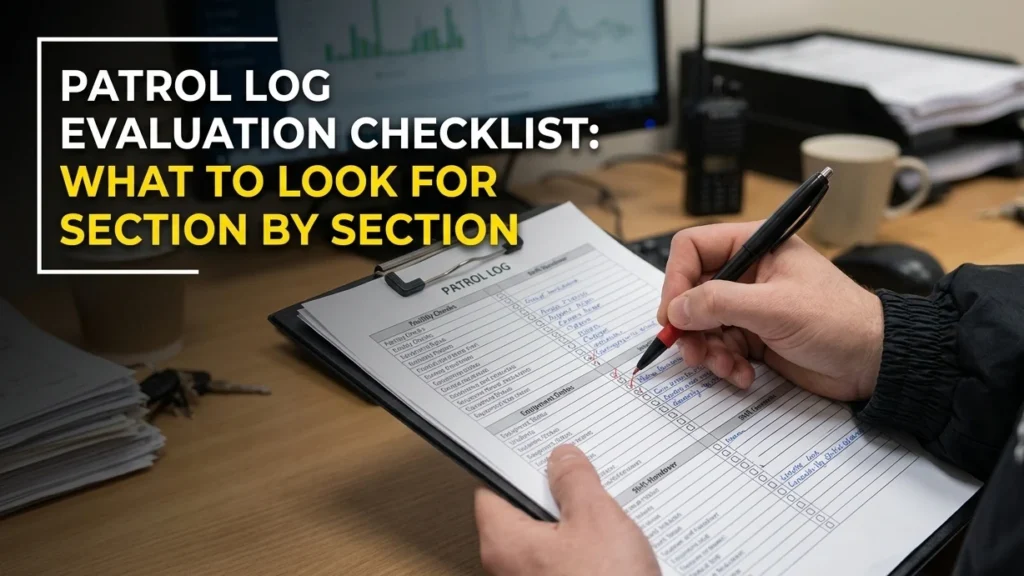
Patrol Log Evaluation Checklist: What to Look for Section by Section
Once you know what a log is supposed to do, the next step is a structured patrol log evaluation checklist you can run against any shift, any guard, any property type.
1. Route Completion and Time Accuracy
Check whether timestamps and locations line up with the assigned route and expected patrol frequency. A checkpoint logged at 2:14 a.m. and again at 2:16 a.m. across a large property is worth a second look. A manager should also actively notice gaps in timing or areas skipped without explanation. These are not something to notice weeks later during a dispute.
2. Specificity of Observations
“All clear” tells you almost nothing. A useful entry names the fixture, door, or area checked and describes its actual condition. “Rear gate secured, latch functioning” gives you something to act on. This specificity is what makes a log usable months later, whether you are reviewing a trend or defending a claim.
3. Exception Handling and Follow-Up Ownership
When a guard flags an issue, the log should show what action was taken, who was notified, and who owns the follow-up. A broken light noted once and never mentioned again is a loose end that should not be ignored. If the log doesn’t show resolution, the property manager is the one left exposed when that same issue causes a bigger problem later.
4. Objective, Non-Speculative Language
Good documentation describes behavior and facts, not assumptions. “Individual observed near loading dock at 11:40 p.m., left when approached” holds up. “Suspicious person who looked like they were up to no good” does not. Watching for factual, behavior-based language protects both residents and the property from liability tied to sloppy or speculative documentation.
Run every log through this compact checklist:
- Timeliness: Was the log submitted promptly, not batched or backfilled at shift’s end?
- Coverage: Do timestamps show every assigned checkpoint, not just the start and finish?
- Detail: Are locations, conditions, and actions specific enough to act on?
- Closure: Does every flagged issue show a named owner and next step?
Red Flags That Signal a Weak Patrol Log or an Underperforming Vendor
One weak entry is usually a coaching issue between a supervisor and a guard. However, if the pattern keeps repeating across shifts, it points to a bigger vendor performance problem worth raising directly. Reading logs in aggregate, not just one at a time, can help property managers catch trouble early.
Watch for these patterns across weeks of security patrol logs:
- The same areas get marked complete at nearly identical times every shift, suggesting a predictable, unverified route
- Incident-adjacent entries are unusually short or missing detail compared to routine ones
- Maintenance issues like broken lighting or damaged gates appear repeatedly without resolution
- Entries read identically across different guards, which often means copy-paste habits rather than real observation
Building Property Management Security Reports from Patrol Log Data
Individual log reviews are useful day to day, but owners and boards need something broader. That means turning daily patrol records into recurring property management security reports.
Metrics Worth Tracking Over Time
Patrol adherence, incident frequency by location, and average time-to-notification are the core metrics that turn scattered logs into an actual management tool. Adherence shows whether routes are being run as scheduled. Location trends show where problems cluster. Notification speed shows how fast issues move from guard to manager. These numbers carry more weight with boards and ownership than any single narrative entry.
Setting a Review Cadence
A tiered review rhythm works better than reviewing everything at once. Do a quick daily scan for urgent flags, a deeper weekly pass to catch patterns across shifts, and a monthly rollup for owner or board reporting. Cadence matters as much as content here. A great checklist reviewed too rarely still lets problems sit unnoticed for weeks.
Patrol Logs vs. Incident Reports: Why Property Managers Should Evaluate Them Differently
Routine patrol logs document normal conditions across a shift, such as lighting, doors, and general property status. Incident reports document a deviation from that normal, things like trespassing, property damage, or a medical event. Instead of listing the status of every checkpoint, an incident report documents a clear sequence of events, named parties involved, and how quickly the incident was reported up the chain.
Working With Your Security Provider to Strengthen Patrol Documentation
Bring specific, dated examples to vendor check-ins instead of general complaints about sloppy logs. Naming the exact gap (a missed checkpoint on Tuesday’s overnight shift, a vague entry after a maintenance flag) gives supervisors something concrete to correct with their team. Vague feedback produces vague fixes. Specific feedback produces a specific conversation with the guard involved.
The stronger move is setting documentation standards directly into the security contract or scope of work. Spell out expected detail level, submission timing, and escalation steps in writing, rather than assuming everyone shares the same definition of a thorough log. Clear expectations up front make patrol log review faster and disputes with a vendor much shorter.
Get Documentation You Can Actually Rely On
Strong patrol log review only works if the logs behind it are accurate to begin with. All Florida Security Services provides trained, licensed security guards across Florida who understand post orders, checkpoint verification, and detailed, time-stamped documentation from the first shift on.
Reach out to All Florida Security Services to talk through your property’s coverage and documentation needs.
Frequently Asked Questions
How often should a property manager review security patrol logs?
Review logs weekly at minimum, with a same-day scan for any flagged incidents that need faster attention or follow-up from the property team.
What is the difference between a patrol log and an incident report?
A patrol log documents routine, expected conditions during a shift, while an incident report documents a specific deviation from that normal activity.
Can patrol logs be used in legal or insurance disputes?
Yes, when they include specific timestamps, objective observations, and documented follow-up, which is why detail and consistency matter more than sheer volume.