Most security officers in Florida start their careers with an unarmed license. That gets you through the job market’s door, but it does not always get you the best contracts. High-value sites and event venues are increasingly asking for guards who carry certified less-lethal tools. The expandable baton is one of the most in-demand of those tools, and getting certified opens doors that an unarmed license simply won’t.
This article covers expandable baton training and how it helps Florida security officers level up their skill set for better employment opportunities.
Why Florida’s Private Security Market Demands Baton-Certified Officers
The Florida private security market has shifted in the last few years. Clients are more specific about what they want from their security teams. Site supervisors now screen for personnel who can demonstrate a full range of security officer skills. An unarmed guard may deter low-level threats, but additional certified security weapons training signals a much higher level of preparedness to a client.
High-demand contract categories that commonly require baton certification include:
- Corporate campus and business park security
- Nightclub, bar, and live entertainment venues
- Government facility and infrastructure protection
- Healthcare and mental health facility security
- Construction sites and equipment yard protection
What Is an Expandable Baton and Where Does It Fit in Use-of-Force?
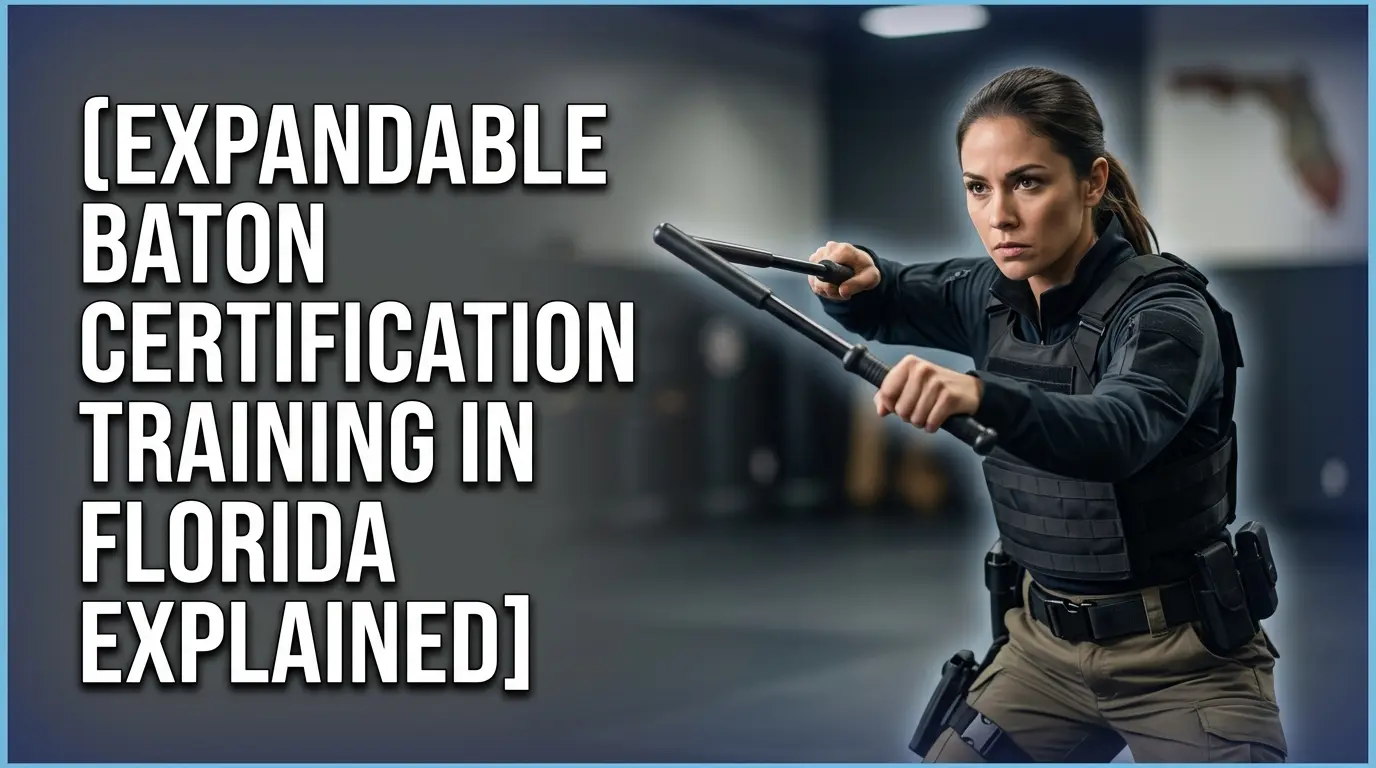
An expandable baton (commonly called an ASP baton after the leading manufacturer) is a collapsible impact tool used in intermediate force situations. It deploys through inertia-based motion (with a flick or swing of the wrist) and locks into an extended position for use. It collapses for compact carry and storage on a duty belt.
Use-of-force guidelines place the expandable baton in the intermediate zone. That means it sits above verbal commands and physical presence, but below deadly force. It is used when a subject is actively resistant or poses a physical threat, and verbal de-escalation has failed.
Security officers should understand use-of-force principles before carrying an expandable baton. Baton certification courses typically cover legal considerations, de-escalation techniques, and the appropriate use of force in accordance with applicable laws and employer policies.
Legal Use of Force in Florida
Florida statutes are clear: security officers may only use force that is reasonable and proportional to the threat. Deploying an impact weapon against a non-resistant subject is a criminal act and a civil liability. All Florida Security Services’ Handcuff, Pepper Spray, Expandable Baton Training in Florida will cover the legal boundaries in detail so you never cross that line.
What to Expect Inside an Expandable Baton Course
The expandable baton course combines classroom instruction with supervised hands-on tactical exercises. Here is what a quality training program covers from start to finish.
Classroom Instruction and Legal Framework
The first block of any solid baton training Florida program covers the legal use of force. Instructors walk you through Florida statutes, your rights and limits as a licensed security officer, and the documentation requirements after any use-of-force incident.
You will work through real scenarios, including verbal and physical confrontations where force may or may not be justified, and how to write an accurate incident report after the fact. Understanding the law protects both you and your employer.
Baton Handling and Tactical Techniques
The practical block of the course focuses on baton control skills under realistic conditions. Instructors teach you how to draw and deploy the tool efficiently. You will practice target areas, defensive blocks, and controlled strikes during hands-on tactical exercises.
Key baton handling skills covered in quality certification programs include:
- Drawing from a holster under stress without fumbling
- One-handed and two-handed grip techniques for control
- Defensive blocks to protect your body while maintaining command presence
- Legal target zones — understanding what areas are permitted to hit and what are not
- Transitioning from verbal commands to tool deployment without hesitation
- Recollapsing and securing the baton after deployment
Situational Awareness and Threat Assessment
Baton skills alone don’t make a complete officer. Strong defense tactics training also develops the judgment you need in case a physical encounter takes place. You will work on reading body language, identifying pre-attack indicators, and positioning yourself to maintain control of the situation.
Situational awareness is one of the most overlooked security officer skills in the field. Officers who develop this get fewer injuries and fewer use-of-force incidents overall. Remember that the baton is the last resort; awareness is the first line of defense.
Conflict De-Escalation Methods
Before you ever reach for a tool, you should have several verbal and positional options on the table. Instructors in quality guard defense training programs teach communication techniques and tone management to reduce the need for force.
Contrary to what many might think, de-escalation in the security industry is not weakness. It is professional security service at its best. Officers who can de-escalate a situation without drawing a tool are the ones clients trust with their high-traffic venues and public-facing roles.
Who Should Take the Baton Certification Class
Not every security officer needs this certification on day one. But if you are in any of the following situations, it is worth scheduling a baton certification class sooner rather than later.
You should strongly consider this course if you:
- Currently hold a Florida Class D unarmed security license and want higher-paying posts
- Work or want to work at nightclubs, events, or venues where physical confrontations are likely
- Are applying to contracts that list defensive tools as a requirement
- Want to qualify for armed escort roles that require a complete defensive toolkit
- Work at behavioral health facilities where staff-on-patient or patient-on-staff incidents occur
For aspiring security officers who are not yet licensed at all, you will need to complete your Class D unarmed course first. The expandable baton course is a separate add-on certification, not a replacement for your primary license (guard card).
How Baton Certification Boosts Your Marketability in the Florida Security Market
Here is the practical reality: among the security officers in Florida with a valid Class D license, few have documented certification in intermediate defense tools. That gap is exactly where certified officers gain a competitive edge.
Florida security contractors who bid on government or corporate contracts often face client requirements that specify certified less-lethal capability. When a company needs to fill that post, they go to the officers who already have it on file. Certification shows up on your training record, and hiring managers look for it.
Pay rates also reflect the difference. Officers with intermediate force certifications often qualify for specialized posts that pay more per hour than standard unarmed patrol.
What to Look for in a Quality Baton Training Program in Florida
When you are researching where to take your expandable baton course, these are the markers of a program worth your time and money.
A quality Florida baton training program should include:
- Instruction from certified professionals with real field experience
- A clear legal framework section covering Florida statutes and use-of-force guidelines
- Hands-on tactical exercises with supervised repetitions, not just a demonstration
- Realistic scenario work, including verbal escalation and physical confrontations
- Documentation of completion that is recognized by Florida-licensed security employers
- Small class sizes so every student gets meaningful floor time with the instructor
Ask upfront whether the certification is accepted by major Florida security service companies and whether the instructor has a valid license. A reputable school will have straightforward answers to both questions.
Combining Baton Training with Other Certifications
The expandable baton course works best when it is part of a broader certification package. Many Florida security training schools offer combined courses that bundle baton training with handcuffing and OC (pepper) spray in a single session.
Taking these certifications together has real advantages. You build a complete intermediate-force toolkit in one training cycle. You also train in tool transitions, which helps during real incidents where you rarely use just one tool in isolation.
Additional certifications worth pairing with your baton course include:
- OC/Pepper spray certification for chemical intermediate force capability
- Handcuffing certification to complete your restraint and control skill set
- Stop the Bleed training for emergency medical response on duty
- First Aid, CPR, and AED certification for public safety responsibility
Ready to Get Certified? Here’s Your Next Step
If you are serious about advancing your career in Florida’s private security field, expandable baton certification is one of the most direct moves you can make. The training is focused, the skills are immediately applicable, and the certification puts you ahead of most officers competing for the same posts.
All Florida Security Services, located in Port St. Lucie, offers hands-on baton training for security officers across Florida. Their course combines the expandable baton with handcuffing and OC spray in a single practical session, giving you three certifications in one day of training. Their instructors bring real field experience into the classroom, not just textbook knowledge.
Visit All Florida Security Services’ website or call (772) 595-5335 to register for the next available class. Spots fill quickly, so reach out early to secure your seat.
Frequently Asked Questions
Do I need a Florida security license before taking the expandable baton course?
Not always. Some schools allow students to enroll in a baton certification class before receiving their Class D license. However, expandable baton certification is an add-on credential and does not replace the Florida Class D Security Officer License required to work as a security officer.
Is the expandable baton certification the same as a baton permit in Florida?
Florida does not issue a separate baton permit. Baton certification documents that you have completed training in the safe and appropriate use of an expandable baton. Whether you may carry one on duty will also depend on your employer’s policies and job requirements.
How long does baton training in Florida take?
Most programs complete in a single day. Combined courses that include handcuffing and OC spray run slightly longer but still finish within one full training session.
Will my baton certification transfer if I work for multiple security companies in Florida?
Yes. Your training documentation follows your license record. Any licensed Florida security employer can verify and accept your certification when you apply for placement.